REST vs Streaming APIs for Voice Workloads
REST vs Streaming for Voice AI: Why Your "Simple" Architecture Choice Is Killing Conversational UX
You're building a voice assistant. A user asks a simple question: "What's the weather today?"
Your system needs to capture their audio, transcribe it, process the query, generate a response, and speak it back. Straightforward, right?
Here's where most developers make a critical architectural decision without realizing how much it matters: REST or streaming?
Most teams default to REST because it's familiar territory. Send a request, get a response. Stateless, simple, works everywhere. Every developer knows HTTP. Every language has libraries for it. It's the path of least resistance.
But here's the uncomfortable truth: for voice workloads, REST's simplicity is a trap that makes conversational experiences feel fundamentally broken. Your users aren't sending batch jobs. They're having conversations. And conversations have timing requirements that REST architectures can't meet.
Let me show you exactly why this choice matters more than almost any other architectural decision you'll make.
Understanding the Fundamental Difference (It's Not Just Protocol)
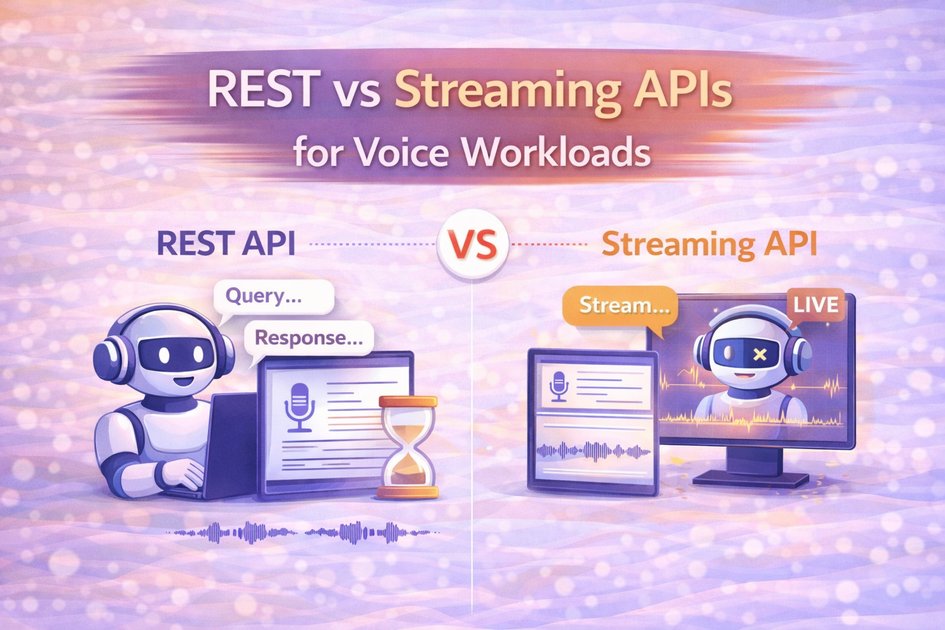
REST APIs operate on request-response cycles. You collect complete audio, upload it as a file, wait for processing, receive complete results. Each interaction is stateless and independent.
Think of it like mailing a letter: you write everything you want to say, seal the envelope, send it, wait days, and eventually receive a complete reply. There's no back-and-forth. No progressive understanding. Just complete messages exchanged with delays between them.
Streaming APIs—typically implemented over WebSockets—maintain persistent bidirectional connections. Audio flows continuously in small chunks. Processing happens progressively. Results stream back as they're generated.
Think of it like a phone call: you start speaking, they hear you in real-time, they can respond while you're still formulating your next thought. The conversation flows naturally with minimal delay.
This isn't a minor technical distinction. This is the difference between interactions that feel mechanical and ones that feel human.
The Latency Death Spiral of REST for Voice
Let's walk through a typical voice query workflow using REST, and I'll show you exactly where time vanishes.
Step 1: Endpoint Detection (300-500ms)
User stops speaking. Your client must detect that they're actually done, not just pausing mid-sentence. Wait 300-500ms to be confident. You've already burned half your latency budget on silence.
Step 2: Upload Complete Audio (50-200ms)
Buffer the complete audio file. Upload it. On good WiFi: 50ms. On cellular networks: 200ms. In areas with poor connectivity: even worse.
You haven't even started processing yet.
Step 3: Server Processing (200-400ms)
ASR transcription runs: 200ms for a typical query. Server processes the request, generates response. Return transcription. Download the text response: 50ms.
Total latency before you even start understanding what the user wants: 800-1200ms.
And we're not done. Now you need to actually respond:
Step 4: Response Generation and Synthesis (1000-1500ms)
Understanding intent, fetching data, generating response text, synthesizing speech, buffering complete audio, downloading audio file.
Your user asked a simple question and waited 2-3 seconds before audio starts playing. That's not a conversation. That's a frustrating waiting game where users feel like they're communicating through molasses.
The problem isn't any individual step being slow. The problem is architectural: REST forces sequential processing with complete buffering at every stage. You can't start the next step until the previous step fully completes.
Understanding the end-to-end latency breakdown in voice AI systems reveals exactly where these milliseconds disappear and why architectural choices compound these delays.
How Streaming Architectures Change Everything
Now let's look at the same workflow using streaming:
Audio chunks stream as they're captured (no waiting for completion). ASR transcribes progressively, returning partial results as the user speaks. You start intent processing before the user finishes their sentence. TTS begins synthesizing early response portions while still generating the rest. Audio playback starts within 200-400ms of the user stopping.
Total perceived latency: under 500ms for audio to begin playing.
This feels conversational. This feels like the system is listening and responding, not processing batch jobs.
The magic isn't faster processing—it's parallelization. Every stage runs concurrently instead of sequentially. While the user is still speaking "...weather today?", you're already transcribing "what's the weather" and potentially fetching weather data. By the time they finish, you're halfway through synthesizing the response.
This is why building low-latency TTS pipelines requires streaming architectures from the ground up—it's not just about optimizing individual components, but fundamentally rethinking how data flows through the system.
When REST Actually Makes Perfect Sense
I'm not saying REST is wrong for all voice workloads. That would be dogmatic and unhelpful. REST excels in specific, important scenarios.
Batch Processing and Offline Workflows
Transcribing pre-recorded podcasts. Generating voiceovers for video content. Processing call center recordings for quality assurance. Bulk converting articles to audiobooks.
These aren't real-time. Users can wait. There's no conversation happening. REST's simplicity—upload file, get results—is perfect here. Why introduce WebSocket complexity when you're literally processing files that already exist in their complete form?
When handling noisy call center audio in batch mode, REST's stateless nature actually simplifies the architecture since you don't need to maintain connection state across potentially long processing times.
Simple, Infrequent Requests
Generating a single audio snippet for an email notification. Converting one article to speech for accessibility. Creating a voicemail greeting. Building a prototype.
These one-off tasks don't benefit from persistent connections. The overhead of establishing a WebSocket, managing its lifecycle, and handling disconnections outweighs any latency savings for a single, isolated request.
Maximum Integration Compatibility
Every programming language has HTTP libraries. Not every environment supports WebSockets easily. Legacy systems, serverless functions with short timeouts, quick integrations, environments behind restrictive corporate proxies—these all favor REST's ubiquity.
Sometimes the best architecture is the one that actually ships, and REST's universality is a real advantage. Understanding how to design clean audio AI APIs helps you build REST endpoints that developers can actually use successfully.
When Simplicity Trumps Performance
If your team doesn't have experience with WebSocket infrastructure, if you're under tight deadlines, if you're building an MVP to validate product-market fit—REST gets you to production faster.
Premature optimization is real. Not every voice application needs sub-500ms latency. If yours doesn't, REST is perfectly fine.
When Streaming Becomes Non-Negotiable
For certain use cases, streaming isn't an optimization—it's a requirement.
Real-Time Conversations
Voice assistants. Customer service bots. Interactive voice response systems. Dictation interfaces. Voice-controlled applications.
Users expect conversational latency: sub-500ms response times. Only streaming architectures achieve this consistently. REST might occasionally get lucky with perfect network conditions and short utterances, but it can't reliably deliver conversational UX.
When building for Indian language ASR, streaming becomes even more critical because you need to handle code-switching in real-time without the latency overhead of batch processing.
Progressive Results That Improve UX
Starting to display transcription while users are still speaking. Beginning audio playback before TTS finishes generating the complete response. Showing "thinking" indicators based on partial processing.
This parallelization cuts perceived latency dramatically. Users don't experience the system as slow because they see progress happening in real-time.
Understanding streaming ASR's impossible balancing act helps you design systems that deliver partial results without sacrificing accuracy.
Long-Form Content Generation
Transcribing a 30-minute interview. Generating a 10-minute narration. Converting hour-long lectures to text.
With REST, you wait for the entire process to complete before receiving anything. With streaming, you start getting results immediately and can display/save them progressively. For a 30-minute transcription, users see the first sentences within seconds, not after 30 minutes.
For long-form TTS, word-level timestamps become essential for synchronizing progressive audio playback with visual elements, which is only practical with streaming architectures.
Bandwidth and Memory Efficiency
Streaming sends data as it's generated. REST must buffer complete results before sending.
For a 5-minute TTS audio file, streaming starts playback almost immediately with only a small buffer. REST waits until all 5 minutes are synthesized, then sends a multi-megabyte file. The user experience difference is massive.
Proper audio normalization across streaming chunks requires careful state management, but the UX benefits far outweigh the implementation complexity.
The Technical Trade-offs You Need to Understand
Let's be honest about the costs of each approach.
Complexity
REST is stateless and simple. Each request is independent. Errors are straightforward: send bad request, get error response. Testing is trivial. Debugging is easy.
WebSockets require connection management, reconnection logic, state tracking. What happens when connections drop mid-stream? How do you handle message ordering? What about partial results delivered before failures? Your error handling needs to be dramatically more sophisticated.
Infrastructure and Scaling
REST scales horizontally trivially. Each request is independent. Spin up more servers, load balance across them, done.
WebSockets maintain state per connection. Scaling requires sticky sessions or sophisticated state management. You can't just load balance randomly—connections need affinity. Deployments become trickier because you can't just kill servers; you need graceful connection draining.
Understanding CPU-friendly audio inference techniques becomes even more critical when you're maintaining persistent WebSocket connections that need to process audio continuously without breaking the bank on infrastructure costs.
Network Reality
HTTP/HTTPS works everywhere. Every network supports it. Every firewall allows it.
WebSockets can be blocked by corporate firewalls, proxies, and network security tools that don't understand them. Enterprise deployments often require fallback strategies: try WebSocket, fall back to long polling or chunked HTTP if that fails.
This isn't hypothetical. Real users in real corporate environments will fail to connect via WebSocket and need alternatives.
When building real-time noise suppression for telephony audio, WebSocket restrictions in telecom infrastructure often force hybrid architectures that gracefully degrade to REST when needed.
Development and Debugging
HTTP requests and responses are easy to inspect. Browser dev tools, curl, Postman—everything works out of the box.
WebSocket debugging requires specialized tools. Messages flow bidirectionally. Timing matters. Replaying failed sessions is harder. Your development and debugging workflow becomes more complex.
The Hybrid Approach: Meeting Developers Where They Are
Many production systems offer both, and this isn't redundancy—it's smart product design.
REST endpoints for developers who need simplicity, are processing pre-recorded content, or are building batch workflows.
WebSocket endpoints for those building conversational experiences where latency matters.
Same underlying models. Same core functionality. Different delivery mechanisms optimized for different use cases.
A podcast transcription service benefits from REST's simplicity. A real-time voice assistant needs WebSocket's low latency. Both are valid. Both serve real needs.
Forcing everyone into one architecture means either over-engineering simple use cases or under-serving latency-sensitive ones. Offering both lets developers choose the right tool for their specific job.
When supporting code-mixed TTS, hybrid architectures let developers use REST for pre-recorded content generation and streaming for real-time conversational applications—each optimized for its use case.
The Industry Trajectory: Streaming Is Winning for User-Facing Apps
The voice AI industry is moving toward streaming for user-facing applications because the latency benefits are too significant to ignore.
Users increasingly expect voice interfaces to feel conversational. Anything that feels like "submit and wait" is perceived as broken. The bar for acceptable latency keeps dropping as users get spoiled by the best implementations.
But this doesn't mean REST is dying. It means REST is finding its proper niche: batch processing, integrations, and scenarios where simplicity or compatibility trumps real-time performance.
Both have a place. The key is understanding which place is which.
Making the Right Choice for Your Use Case
Here's the decision framework:
Choose streaming when:
Building conversational voice experiences
Latency under 500ms matters to users
Processing long-form content where progressive results improve UX
Users expect real-time responsiveness
Supporting accent-robust ASR that needs immediate feedback
Evaluating ASR beyond WER in real conversational contexts
Choose REST when:
Processing pre-recorded content in batch
Simplicity and integration compatibility are priorities
Latency over 1-2 seconds is acceptable
Building MVPs or prototypes quickly
Operating in environments with WebSocket restrictions
Building your own TTS pipeline for offline content generation
Offer both when:
You're building a platform serving diverse use cases
You want maximum developer adoption
Different customer segments have different requirements
Supporting both real-time voice agents and batch processing workflows
The worst choice is defaulting to REST without considering streaming, or forcing streaming onto use cases that don't need it. The best API architecture is the one that fits your actual requirements.
The Path Forward
Voice AI is evolving rapidly, and architectural patterns are evolving with it. Streaming is becoming the expected standard for conversational applications. But REST remains the right choice for enormous categories of voice workloads.
The teams that succeed are those that understand the trade-offs deeply and choose deliberately, not those that cargo-cult one approach because it's "modern" or "simple."
Build for your users' actual needs. If they're having conversations, stream. If they're processing files, use REST. If you serve both use cases, offer both APIs.
When dealing with complex audio challenges like noise cancellation in complex acoustic environments or understanding why aggressive denoising hurts ASR accuracy, the right architecture choice amplifies your preprocessing quality—or undermines it through latency overhead.
Because natural voice experiences aren't about choosing the "best" architecture in abstract. They're about matching your technical approach to the human experience you're trying to create.
And that's a choice only you can make based on what you're actually building.