
How to Improve Speech Recognition Accuracy in Noisy Call Centers
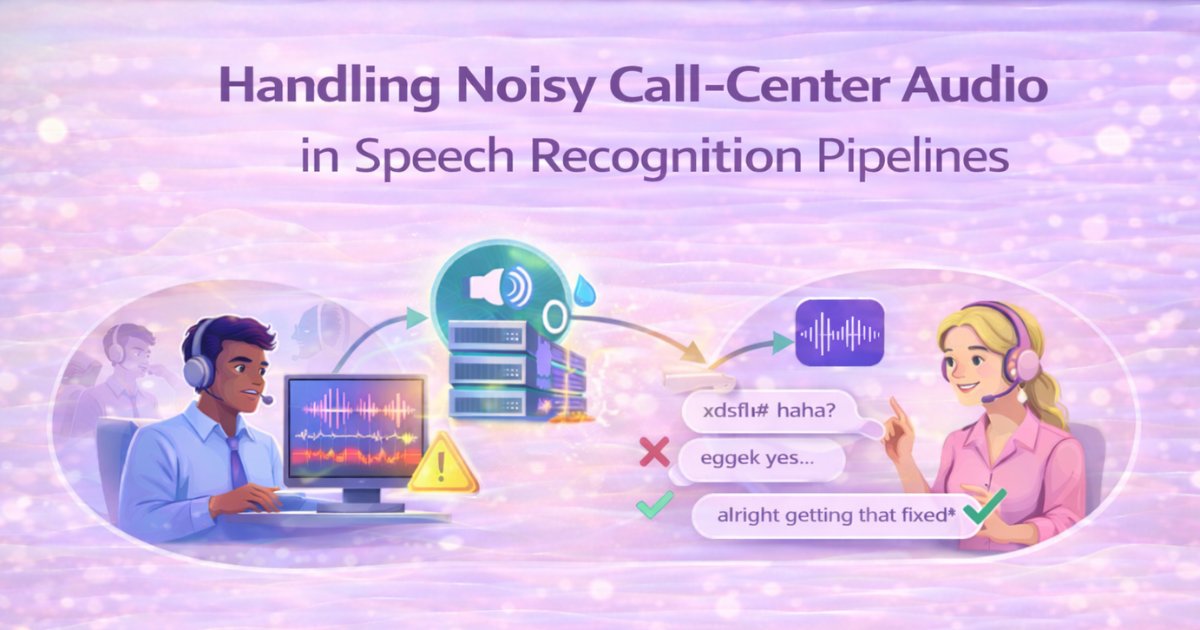
Call center audio is where ASR systems go to die.
You'd think call centers would have pristine audio quality. Clear communication is literally their job. But in reality? Absolute nightmare fuel: background chatter, keyboard clicking, distorted phone lines, people talking over each other, hold music bleeding through, and compression artifacts from telephony systems built when disco was cool.
Oh, and the ASR system is expected to transcribe all of this perfectly in real time. No pressure.
Building ASR that actually works on call center audio requires understanding not just what noise is, but where it comes from, how it murders speech signals, and why standard denoising often makes things worse.
Why Call Center Audio Is Uniquely Terrible
Call center audio combines every audio quality problem into one toxic cocktail.
Telephony compression from hell: Most calls go through phone networks designed in the 1960s. Audio is bandlimited to 300-3400 Hz, compressed brutally, and passed through countless intermediary systems. By the time it reaches your ASR pipeline, you've lost most acoustic information that distinguishes similar sounds. "Fifteen" versus "fifty"? Good luck when you can't hear the full frequency range of those /f/ sounds.
Multi-talker chaos: Agents and customers talk over each other. Background conversations from adjacent cubicles bleed in. The ASR has to figure out who's saying what, when, and what to ignore. Unlike clean podcast audio where one person speaks at a time, this is conversational chaos.
Environmental warfare: Call centers are loud. Dozens of agents in open floor plans, all talking simultaneously. Printers, AC, coffee machines, doors slamming. This isn't gentle background hum, it's competing speech and mechanical noise that sometimes rivals the actual conversation. Worse, it's not consistent. It spikes when someone laughs three desks over, drops when the AC cycles, and changes throughout the day.
Equipment lottery: Some agents have quality USB headsets. Others use whatever cheap garbage came with the computer. Some calls come through mobile phones, others through VoIP with varying quality, some through ancient landlines with physical line noise. Your ASR pipeline handles all of this without knowing what's coming.
Accents under stress: Call center agents often speak non-native languages or handle customers from diverse backgrounds. Add stress (angry customers, high call volumes), and pronunciation degrades. People speak faster, mumble, use non-standard phrasing. In Indian call centers, this multiplies; agents code-mix, customers speak regional languages, and both deal with telephony quality issues simultaneously.
Where Noise Breaks The Pipeline
Noise doesn't reduce accuracy uniformly. It breaks specific parts in specific ways.
Voice Activity Detection dies first: Before transcribing, the system detects when someone is speaking. In clean audio, easy. In noisy audio, background chatter gets misclassified as speech, or actual speech gets classified as noise. The system transcribes background conversations or cuts off actual speech mid-word.
Feature extraction gets wrecked: ASR extracts acoustic features from audio. These should capture speech while ignoring noise. But noise doesn't politely stay in separate frequency bands. It overlaps, distorts features, makes similar words indistinguishable. When "can" and "can't" sound identical because noise masked the /t/, the system guesses from context. Sometimes it guesses wrong.
Confidence scores collapse: In noisy audio, confidence scores become unreliable. The model might be very confident about a wrong transcription because noise happened to sound like a word. This breaks downstream systems relying on confidence for error handling.
Language model bias amplifies: When acoustic signals are unclear, ASR leans harder on language models to guess what was probably said. This creates bias toward common phrases and misses domain-specific terminology. Call center customers describe weird edge cases, use product names not in common vocabulary, and phrase things unexpectedly.
Preprocessing: Help Or Harm?
Noise reduction gamble: Standard algorithms try removing background noise while preserving speech. Great in theory. In practice, aggressive noise reduction often removes parts of speech, especially consonants and high-frequency sounds. Key: conservative noise reduction. Remove obvious steady-state noise (AC hum, fans) but leave anything speech-related. Better to send slightly noisy audio than heavily processed audio that's lost acoustic information.
Bandpass filtering wins: Since phone audio is already bandlimited to 300-3400 Hz, apply a bandpass filter to remove frequencies outside this range. You're not losing information (it was never there), but you're removing noise outside the telephony band. One of the few preprocessing steps with almost no downside.
Volume normalization trap: Normalizing volume seems sensible, but volume differences carry information. One speaker being louder might indicate they're closer to the microphone (agent) versus farther (background noise). Aggressive normalization amplifies background noise to the same level as primary speech, making things worse.
Model Architectures For Noisy Audio
ASR models trained on clean audio fail on noise. Models designed for noisy audio make different choices.
Noise-robust features: Instead of standard mel spectrograms, use Perceptual Linear Prediction (PLP), RASTA filtering, or learned features from denoising autoencoders. These preserve speech while being less sensitive to noise. Tradeoff: more computation, might lose subtle acoustic distinctions.
Multi-condition training: Train on speech with various noise types artificially added. The model learns to recognize speech even when partially masked. Works well when training noise matches deployment noise. But call center audio has such diverse noise patterns it's hard to simulate everything.
Attention for noise: Modern ASR uses attention mechanisms to focus on relevant audio parts. Training these to learn which parts are noise versus speech improves robustness. The model learns "sustained hum is probably noise" or "brief high-frequency burst is keyboard clicking, not speech."
Real-Time Constraints & Post-Processing
Call center ASR often needs real-time operation. You have maybe 200-300ms to process each audio chunk before the next arrives. This rules out heavy preprocessing or complex ensembles. Solution: optimize ruthlessly. Use smaller models, efficient preprocessing, accept slightly lower accuracy for meeting latency requirements.
Buffering trick: Cheat a little by buffering a few hundred milliseconds. This gives look-ahead context, helping with noise detection and accuracy. Tradeoff: increased latency. For agent assist where 500ms delay is acceptable, buffering helps. For live captions where users expect instant response, too slow.
Even with good preprocessing and robust models, errors happen. Post-processing strategies include:
Confidence filtering: Discard or flag low-confidence transcriptions. Better to return "unable to transcribe" than confidently return garbage.
Context correction: Use dialogue context and conversation history to fix obvious errors. If the agent just asked "can I have your account number?" and the transcription is "yes purple elephant," you know something's wrong.
Domain vocabulary boosting: Call centers use specific terminology. Boost probability of these terms during transcription, even when acoustic evidence is weak. Helps when the system might misrecognize "refund policy" as "refuse properly" without domain context.
Measuring Success In Noisy Conditions
Standard Word Error Rate doesn't tell the full story.
Noise-stratified metrics: Measure accuracy separately for clean segments, moderate noise, heavy noise. A system might have 5% WER on clean audio, 15% on moderate noise, 40% on heavy noise. The average hides this distribution.
Usability metrics: Track how often users correct transcripts, how often agents complain, whether the system actually gets used. A technically impressive model that agents don't trust is useless.
Where FonadaLabs Fits In
At FonadaLabs, our ASR is built for real production environments, not just clean demo audio. We design for situations where audio quality is far from ideal and conditions constantly change.
Our models train on diverse datasets including noise, accents, and speech patterns from actual Indian call centers. Customer support calls with background noise? Telephony compression artifacts? Agents and customers code-mixing under pressure? The system keeps working.
For call centers specifically, our batch processing handles large volumes of recorded calls for QA and analytics, while our real-time streaming API supports live transcription for agent assist and compliance monitoring.
The Realistic Path Forward
Perfect transcription of noisy call center audio is impossible. The goal isn't perfection, it's utility.
Can the system transcribe well enough that QA teams review calls faster? Agents get useful real-time suggestions? Analytics extract meaningful insights? Compliance requirements are met? If yes, the ASR is working, even if accuracy isn't 100%.
Building call center ASR means accepting tradeoffs: speed vs accuracy, preprocessing complexity vs latency, noise reduction vs speech preservation, generic robustness vs domain optimization. The best systems find the right balance for their use case rather than chasing impossible perfection.
Call center audio will always be noisy. The question isn't whether we can eliminate noise. It's whether we can build systems robust enough that noise becomes manageable rather than mission-critical.
For call centers depending on voice communication, that robustness isn't optional. It's the difference between ASR being a useful tool or an expensive failure.