Code-Mixed Text-to-Speech Explained
Code-Mixed Text-to-Speech: The Multilingual Challenge Breaking Traditional TTS Systems
Picture this: you're building a voice assistant for the Indian market. Your TTS system handles Hindi beautifully. Your English synthesis is flawless. But then a user sends this perfectly normal input: "Mujhe kal meeting ke liye presentation prepare karna hai."
Your system chokes. Hard.
This isn't Hindi. It isn't English. It's both, woven together in a single sentence the way hundreds of millions of people actually speak. This is code-mixing, and it's the linguistic reality that's breaking traditional TTS systems across multilingual markets worldwide.
If your TTS pipeline assumes clean, single-language input, you're not building for the real world. You're building for a sanitized version of it that doesn't exist outside of textbooks and language learning apps.
What Code-Mixing Actually Is (And Why It's Everywhere)
Code-mixing is the seamless blending of two or more languages within a single utterance, sentence, or conversation. Not awkward switching. Not accidental mixing. Intentional, natural, grammatically structured multilingual speech that feels completely normal to native speakers.
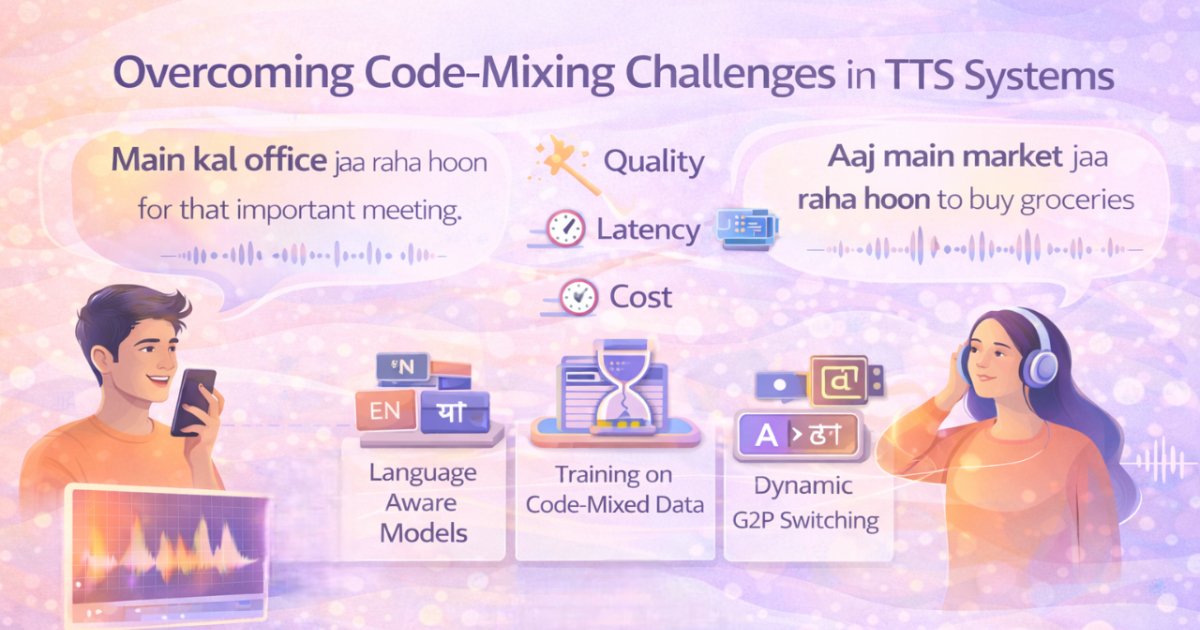
"I'm going to the market" becomes "Main market ja raha hoon." "Can you send me the files?" becomes "Kya tum mujhe files bhej sakte ho?" This isn't broken language—it's how actual humans communicate in multilingual contexts.
The scale of this phenomenon is staggering. In India alone, over 500 million people regularly code-mix between regional languages and English. Similar patterns exist in Singapore (English-Mandarin-Malay), the Philippines (Tagalog-English), parts of Latin America (Spanish-English), multilingual African nations, and essentially every region where multiple languages coexist in daily life.
Traditional TTS systems treat this as edge-case noise. It's not. For billions of speakers, code-mixing is the default mode of communication.
Why Traditional TTS Systems Catastrophically Fail at Code-Mixing
Most TTS systems are built on a fundamental assumption: one input sentence equals one language. This assumption is baked into every layer of the architecture.
The Language Detection Trap
When faced with mixed input, naive systems try to detect "the" language. They analyze the sentence, decide it's 60% Hindi based on token count, and synthesize everything with Hindi phonemes and prosody. The embedded English words sound absurd—mangled pronunciation, wrong stress patterns, completely unnatural.
Or they detect English as dominant and synthesize the whole thing in English. Now the Hindi portions are butchered, pronounced as if English phonemes could somehow represent Devanagari sounds. "Mujhe" becomes something unrecognizable.
Neither approach works. You can't force code-mixed text into a single-language box without destroying naturalness. Understanding why TTS doesn't work in Hinglish reveals the specific challenges of Hindi-English code-mixing.
The Phoneme Mapping Problem
Different languages use fundamentally different phoneme sets. English has roughly 44 phonemes. Hindi has around 52, including retroflex consonants that don't exist in English, aspirated/unaspirated contrasts, and different vowel inventories.
When you switch languages mid-sentence, you need to switch phoneme mappings mid-sentence. Your text-to-phoneme conversion system needs to recognize that "meeting" should use English phonemes while "karna" requires Hindi phonemes—within the same utterance.
Standard TTS systems aren't built for this. They assume uniform phoneme mapping across entire inputs. Code-mixing breaks this assumption instantly.
The Prosody Discontinuity Disaster
Prosody—the rhythm, stress, and intonation patterns of speech—varies dramatically between languages. English is stress-timed, with alternating stressed and unstressed syllables creating rhythmic patterns. Hindi is mora-timed, with more even syllable durations and different stress placement rules.
When you switch languages, prosody needs to transition smoothly. The English word "presentation" embedded in a Hindi sentence can't have jarring English prosody that disrupts the flow. But it also can't have pure Hindi prosody that makes the word sound unnatural.
Finding that balance—preserving each language's prosodic character while maintaining overall coherence—is incredibly difficult. Most systems don't even try. They apply one language's prosody to everything and hope users don't notice.
Users notice. This is where measuring voice naturalness becomes critical—traditional MOS scores often miss these prosodic discontinuities that break user trust.
The Linguistic Complexity Nobody Warns You About
Code-mixing isn't random language switching. It follows complex linguistic patterns that TTS systems need to understand to synthesize naturally.
Intra-Sentential vs. Inter-Sentential Mixing
Inter-sentential code-mixing switches languages between sentences: "I'm going to the office. Wahan pe meeting hai." This is relatively easier for TTS systems because each sentence can be processed independently with its own language model.
Intra-sentential code-mixing switches within sentences: "Office ke meeting mein presentation dena hai." This is the hard case. You can't split it cleanly. The languages are grammatically intertwined. Hindi grammatical structures wrap around English noun phrases. English verbs take Hindi inflections.
Real-world code-mixing is predominantly intra-sentential. And that's exactly what breaks traditional systems.
Matrix Language vs. Embedded Language
Linguistic research shows code-mixing typically has a "matrix language" providing grammatical structure and an "embedded language" contributing lexical items. In "Mujhe meeting attend karni hai," Hindi is the matrix language (providing grammar, inflections, function words), while English provides content words (meeting, attend).
For natural synthesis, the matrix language's prosody should dominate, but embedded language words need authentic pronunciation. You can't pronounce "meeting" with pure Hindi phonemes, but you also can't insert jarring English prosody that breaks the Hindi rhythmic flow.
This nuance is lost on systems that just detect "dominant language" and steamroll everything.
Borrowing vs. Code-Switching
Some words have been borrowed so thoroughly into the target language that they've adapted phonetically. "Computer" in Hindi might be pronounced "kampyootar," fully integrated into Hindi phonology. Other words retain source language pronunciation even when embedded.
TTS systems need lexicons that know which English words are pronounced as loanwords with adapted phonology versus which ones retain English pronunciation in code-mixed contexts. Without this knowledge, synthesis sounds wrong in subtle but noticeable ways.
Architectural Approaches to Code-Mixed TTS
Building TTS systems that handle code-mixing naturally requires rethinking fundamental architectural assumptions.
Language-Aware Token Processing
Instead of detecting one language per input, analyze at the token or phrase level. Tag each word or phrase with its language. Build text-to-phoneme pipelines that switch language models based on these tags, generating appropriate phoneme sequences for each segment.
This solves basic pronunciation issues but creates new challenges: how do you blend prosody across language boundaries? How do you avoid discontinuities at switch points?
Unified Multilingual Acoustic Models
Train acoustic models on massive multilingual datasets that include natural code-mixed speech. Instead of separate English and Hindi models, build a single model that learns to handle both languages and their interactions.
These models learn natural prosody transitions, appropriate blending at language boundaries, and how real bilingual speakers actually sound when code-mixing. The model doesn't treat code-mixing as anomalous—it's part of the training distribution.
The challenge is data. Code-mixed speech corpora are scarce compared to monolingual data. Recording and annotating code-mixed datasets is expensive because you need bilingual annotators who understand the linguistic patterns of specific language pairs.
Understanding trade-offs between neural vocoders becomes even more critical when building multilingual systems that need to handle diverse phonetic inventories efficiently.
Transfer Learning and Adaptation
Start with strong monolingual models for each language, then use transfer learning to adapt them for code-mixed synthesis. The models retain knowledge of each language's phonetics and prosody while learning to blend them naturally.
Adapter layers or attention mechanisms can help models learn when to apply language-specific characteristics versus when to blend them. This approach leverages existing monolingual data while requiring less code-mixed training data than building from scratch.
Prosody Interpolation Strategies
At language switch points, interpolate prosodic features rather than making abrupt changes. Gradually transition from Hindi prosody patterns to English patterns across syllables surrounding the switch point. The transition happens fast enough to feel natural but slow enough to avoid jarring discontinuities.
This requires careful tuning. Too much interpolation and everything sounds averaged and muddy. Too little and you get robotic-sounding switches.
The Challenges That Still Don't Have Great Solutions
Even with sophisticated approaches, code-mixed TTS has unsolved problems that make it an active research area.
Ambiguous Graphemes
Many languages share scripts. "a" appears in both English and romanized Hindi, but represents different sounds. Without context, you can't know which phoneme to generate. "Sahara" could be the English word (suh-HAR-uh) or Hindi transcription (sa-HA-ra).
Solutions require contextual language identification, looking at surrounding words and grammatical patterns to disambiguate. But this fails at boundaries where context is inherently ambiguous.
Script Mixing
Users don't just mix languages—they mix scripts. "Meeting के लिए office जाना है।" Now you're handling Latin and Devanagari in the same sentence, each with different processing pipelines for grapheme-to-phoneme conversion.
This requires unified text processing that can handle multiple scripts simultaneously, recognizing script boundaries and applying appropriate G2P models.
Regional Variation in Code-Mixing Patterns
Code-mixing patterns vary by region, age, education level, and social context. Delhi code-mixing sounds different from Mumbai code-mixing. Younger speakers mix differently than older speakers. Professional contexts have different mixing patterns than casual conversations.
A one-size-fits-all model can't capture this variation. But building separate models for every demographic and regional variation is impractical.
Emotional and Expressive Code-Mixing
Speakers often switch languages for emotional or expressive effect. "Bahut frustrating hai yaar" uses Hindi to express frustration in a culturally specific way that pure English wouldn't capture. "It's totally bakwaas" uses Hindi for emphasis and attitude.
Synthesizing these nuances naturally requires understanding not just which language is used but why it's used—the pragmatic and emotional intent behind code-switching. Current systems barely scratch the surface of this.
Data: The Bottleneck Nobody Talks About Enough
The biggest barrier to high-quality code-mixed TTS isn't algorithmic—it's data.
The Scarcity Problem
High-quality TTS training requires hundreds of hours of clean, annotated speech data. For code-mixed TTS, you need hundreds of hours of natural code-mixed speech with accurate transcriptions, language tags for each word, and ideally prosodic annotations.
This data barely exists. Most speech corpora are carefully curated monolingual datasets. Code-mixed speech is treated as noisy data to be filtered out, not valuable training material.
The Annotation Challenge
Annotating code-mixed data is significantly harder than monolingual data. Annotators need to be fluent in all languages involved, understand linguistic code-mixing patterns, and consistently tag language boundaries. Finding and training these annotators is expensive and time-consuming.
Mistakes in language tagging propagate through the entire pipeline, causing synthesis errors that are hard to debug.
The Naturalness vs. Coverage Trade-off
You can record scripted code-mixed speech from voice actors, giving you clean audio and perfect annotations. But scripted code-mixing often sounds artificial because it doesn't capture the natural patterns of spontaneous code-mixed speech.
Or you can collect natural conversational data with authentic code-mixing patterns. But the audio quality is poor, filled with overlapping speech, background noise, and transcription challenges.
The systems that work best use hybrid approaches: some clean scripted data for training stable base models, augmented with carefully curated natural speech for capturing authentic code-mixing patterns.
Why This Matters More Than You Think
Code-mixed TTS isn't a niche feature for multilingual markets. It's becoming essential infrastructure as voice AI expands globally.
Markets like India, Southeast Asia, parts of Africa, and Latin America represent billions of potential voice AI users. If your TTS system can't handle how these users actually communicate, you're locking yourself out of massive growth opportunities.
Beyond market access, there's an accessibility and inclusion dimension. Forcing users to speak in unnatural, monolingual sentences to interact with voice systems creates barriers. It's not just inconvenient—it's exclusive.
The companies that solve code-mixed TTS well will dominate multilingual voice markets. The ones that don't will struggle to achieve naturalness and user adoption no matter how good their monolingual models are.
When building low-latency TTS pipelines, code-mixed support must be a first-class architectural decision, not an afterthought.
The Path Forward: Engineering Meets Linguistics
Solving code-mixed TTS requires tight collaboration between engineers and linguists. You can't brute-force this problem with more compute and bigger models. You need linguistic understanding of code-mixing patterns, careful data curation, and architectures designed for multilingual complexity from the ground up.
The next generation of TTS systems won't treat code-mixing as an edge case to handle gracefully. They'll treat it as a first-class feature, because that's what matches how billions of people actually speak.
Natural, fluent code-mixed synthesis is the difference between TTS systems that sound robotic and foreign versus ones that sound like they actually understand how users communicate. And in voice AI, that difference determines whether users adopt your technology or ignore it.
Because at the end of the day, people want to talk to machines the way they talk to each other—naturally, mixing languages as needed, without thinking about it. Building systems that match this reality isn't optional. It's the future of multilingual voice AI. Learn how to build your own TTS pipeline with multilingual support from day one, and ensure your implementation uses CPU-friendly audio inference techniques for cost-effective scaling across diverse markets.