
How Streaming Speech to Text Works: Balancing Speed and Accuracy
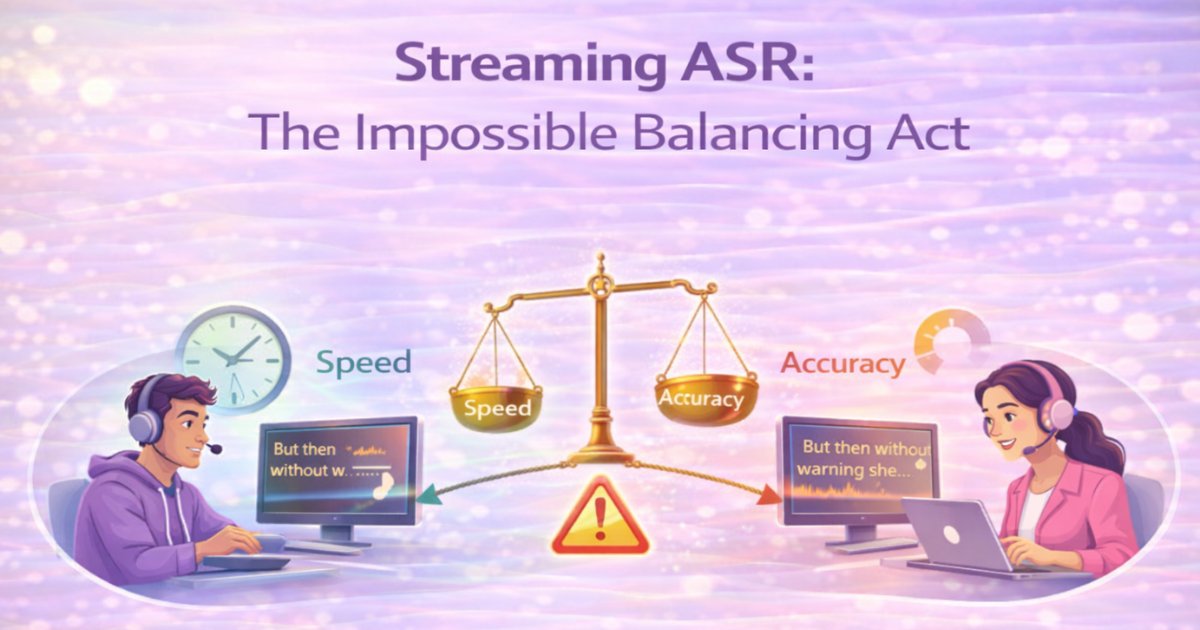
Streaming ASR sounds simple: audio flows in, text flows out. Except every decision creates a domino effect. Want lightning-fast responses? Say goodbye to accuracy. Want perfect transcription? Users abandon your app waiting for text. Add lookahead? You just broke your "real-time" promise.
Why streaming is fundamentally harder: Batch processing gives you the entire audio upfront, you can look ahead, look back, process multiple times. Streaming tears up that playbook. Audio arrives continuously. You decide NOW with incomplete information. No peeking ahead (future hasn't happened), no looking back (users expect instant results).
The Chunk Size Trap
Streaming ASR processes audio in chunks. This single decision determines if your system feels magical or broken.
Small chunks (100-200ms): Text appears instantly but words get cut mid-phoneme, the model lacks context for similar sounds, and stress patterns span multiple chunks.
Result: higher error rates for short words, boundaries, and ambiguous sounds.
Large chunks (1-2 seconds): The model gets full words and phrases to make intelligent decisions but users notice the lag. Voice assistants feel sluggish, live captions trail behind.
The "sweet spot"? Most systems use 200-500ms chunks. But there's no universal answer: live captions tolerate 300-500ms, voice assistants need <200ms, meeting transcription accepts 1 second.
Overlapping chunks: Process audio with sliding windows where chunks overlap. A word cut across boundaries gets fully captured somewhere. The cost? 50% overlap doubles compute. 75% overlap quadruples it. Plus you need post-processing to merge overlapped transcriptions.
Lookahead: The Real-Time Cheat Code
Lookahead means waiting for future audio before deciding about current audio. It works brilliantly, humans do this constantly (hearing "I'm going to the..." doesn't tell you "bank" or "bench" until they finish). ASR models with lookahead use future words to clarify retroactively.
The price: Lookahead directly adds latency. Buffer 500ms? You just added 500ms to system latency. For meeting transcription with 1-2 seconds already, invisible. For voice assistants, that 500ms might double latency and destroy UX.
Adaptive lookahead (variable based on confidence) sounds clever but creates unpredictable latency, sometimes instant, sometimes delayed which can feel worse than consistent delay.
State, Transcripts, and Boundaries
State management: Streaming can't treat chunks independently. Systems maintain acoustic feature buffers from previous chunks to avoid boundary discontinuities, and language model context for conversation history ("Can you email that?" needs to know what "that" means). Challenge: memory accumulates fast with hundreds of concurrent sessions.
Partial vs Final results: Partials appear instantly but change ("whether" → "weather" → "whether"). Finals are stable but delayed. UI dilemma: show flickering partials for responsiveness or wait for stable finals? No perfect answer.
End-of-utterance detection: Silence-based (wait X milliseconds) is simple but tricky too short fragments, natural pauses, too long increases latency, different languages vary. Model-based (using intonation/prosody) works better but costs more compute and still makes mistakes.
The Fundamental Trade-off
You can trade latency for accuracy, but you cannot optimize both simultaneously.
Latency-optimized: Small chunks, minimal lookahead, aggressive boundaries. Nearly instant text, higher error rates. Use for voice commands where 95% accuracy beats 100% late accuracy.
Accuracy-optimized: Large chunks, substantial lookahead, conservative boundaries. Near-batch quality, significant latency. Use for medical/legal transcription where accuracy is critical.
Network reality: Streaming over WebSockets adds chaos. 16kHz audio needs ~300 kbps with overhead. Packet loss creates gaps, jitter complicates timing. If servers can't keep up, you need backpressure mechanisms, slow input, drop frames, reduce quality. Real-time systems can't "catch up later."
Real-World Targets
Voice assistants: <200ms latency, 90-95% accuracy
Live captions: 300-500ms latency, 95-98% accuracy
Meeting transcription: 1-2s latency, 98%+ accuracy
Call centers: 500ms-1s latency, 92-96% accuracy
Practical Survival Guide
Start conservative: Begin with larger chunks and more lookahead. Get accuracy working, then incrementally reduce chunk size while monitoring errors.
Measure what matters: Track latency at P95/P99, not averages. A system with 200ms average but 2s P99 feels broken. Track user corrections and satisfaction, technically impressive systems users don't trust are useless.
Tune per use case: Don't build one configuration for everything. Build flexible systems that adjust parameters.
Monitor in production: Testing conditions differ from real networks, diverse audio, and actual user behavior. Instrument everything.
The Bottom Line
Streaming ASR is all about trade-offs. You can't have zero latency and perfect accuracy. Every parameter affects multiple aspects: reduce chunk size (improve latency, hurt accuracy), add lookahead (improve accuracy, add latency), overlap chunks (better context, double compute).
The goal isn't eliminating trade-offs; it's understanding them well enough to make informed decisions for your specific use case. Voice assistants need different compromises than transcription services. Meeting captions need different settings than voice commands.
Build for your actual requirements, not theoretical perfection. Measure what matters to your users. Adjust as you learn what works in production. There's no universally optimal configuration only what works best for your use case, users, and conditions. Figuring that out? More art than science.
FonadaLabs' streaming ASR balances low latency with strong accuracy through WebSocket-based processing. It handles real-world network instability, variable audio quality, and diverse speech patterns for Indian languages, built for production, not demos.