
How to Improve Audio Quality in VoIP and Telephony: A Guide to Real-Time Noise Suppression
The Symphony of Silence: Why Your Voice Matters More Than Ever
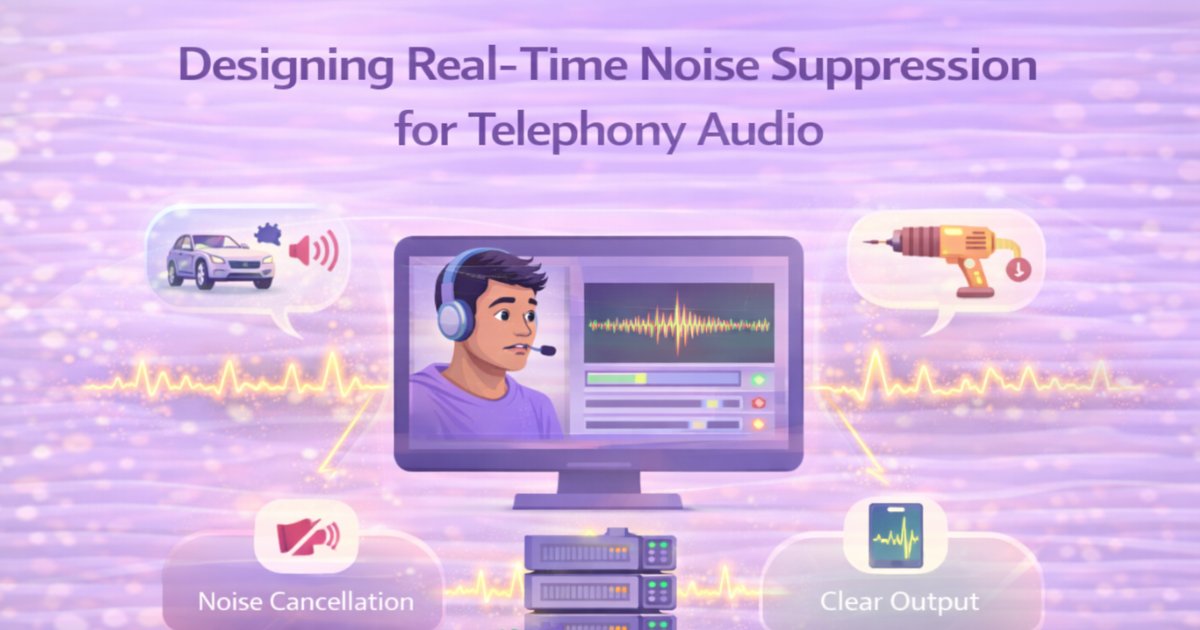
Picture this: You're on the most important call of your career. Your pitch is flawless, your data is compelling, and then WOOF WOOF WOOF your neighbor's dog decides it's the perfect time to announce the mailman's arrival. Or maybe it's the relentless hum of your AC unit, the clatter of a mechanical keyboard, or that mysterious buzzing sound that only appears during video calls.
Welcome to the golden age of remote communication, where crystal-clear audio isn't just nice to have, it's absolutely essential. In this deep dive, we're going to explore how modern noise suppression systems work their magic, transforming chaotic audio streams into pristine conversations in real-time.
The Challenge: Fighting Physics at 20,000 Samples Per Second
Real-time noise suppression in telephony isn't just about making things quieter, it's about performing acoustic surgery at superhuman speeds. Consider the constraints:
The Latency Budget: In telephony applications, you typically have 20-50 milliseconds to process audio before humans start noticing lag. That's right: you need to analyze, process, and output clean audio faster than it takes to blink.
The Bandwidth Battleground: Telephony audio typically samples at 8-16 kHz (narrowband to wideband), with modern systems pushing into 48 kHz (fullband). At 16 kHz sampling, you're processing 16,000 samples every second. Miss your deadline, and you've got audio dropouts, glitches, or the dreaded robotic voice effect.
The Computational Constraint: This all needs to run on devices ranging from high-end workstations to smartphones with thermal throttling, to embedded VoIP hardware with limited CPU cycles. Oh, and it can't drain the battery or spin up the fans like a jet engine.
The Traditional Approach: When Spectral Subtraction Ruled the World
Before we had the luxury of throwing neural networks at every problem, spectral subtraction was the workhorse of noise suppression. The concept is elegantly simple:
Estimate the noise floor during silent periods (when the user isn't speaking)
Transform audio to the frequency domain using the Fast Fourier Transform (FFT)
Subtract the noise spectrum from the signal spectrum
Transform back to time domain with inverse FFT
Here's the beautiful part: noise is often stationary (think AC hum, fan noise), so once you've characterized it, you can subtract it out like removing a watermark from an image.
The painful part? Speech is non-stationary. It changes constantly. And if you subtract too aggressively, you get the dreaded "musical noise," those weird chirping artifacts that make processed audio sound like it's underwater or being played through a dying synthesizer.
The Wiener Filter: A Mathematical Love Story
One of the most elegant classical approaches is the Wiener filter, which asks a deceptively simple question: "What's the optimal linear filter that minimizes the mean squared error between the desired signal and the estimate?"
The Wiener gain is computed as:
G(ω) = S_signal(ω) / (S_signal(ω) + S_noise(ω))
Where S_signal and S_noise are the power spectral densities of speech and noise respectively. This creates a frequency-dependent gain that preserves frequencies where speech dominates and suppresses frequencies where noise reigns supreme.
Enter the Modern Era: Deep Learning Meets DSP
Around 2015-2016, researchers started asking: "What if we could train a neural network to understand what clean speech should sound like?" This wasn't about following rigid mathematical formulas, it was about learning the intricate patterns of human speech from millions of examples.
Recurrent Neural Networks: The Memory Masters
The breakthrough came with RNN-based approaches, particularly those using LSTM (Long Short-Term Memory) or GRU (Gated Recurrent Unit) architectures. These networks have a secret weapon: memory.
Unlike feedforward networks that treat each audio frame independently, RNNs maintain a hidden state that carries information across time. This is crucial because speech has temporal structure: the sounds you're making right now depend on what you said a moment ago.
The beauty is in the output: instead of directly predicting clean speech, many systems predict a time-frequency mask, essentially a map that tells you how much of each frequency at each time point to keep. Multiply your noisy spectrogram by this mask, and voila, clean speech emerges.
The Training Recipe: Building Robust Models
Training these systems requires massive datasets of paired examples: clean speech recordings, noise samples (everything from cafeteria babble to construction sounds), and mixed audio created by algorithmically combining them at various SNR (Signal-to-Noise Ratio) levels.
The network learns by trying to recover the clean speech from the mixture, with the loss function punishing it for every deviation. Modern systems train on thousands of hours of audio, learning to handle everything from crying babies to jackhammers.
The Real-Time Implementation Challenge: Theory Meets Silicon
Training a model is one thing. Running it in real-time with minimal latency is where things get spicy.
Frame-by-Frame Processing: The Sliding Window Dance
Audio gets divided into short frames (typically 10-20ms). Each frame gets processed independently:
Windowing: Apply a Hann or Hamming window to prevent spectral leakage
FFT: Transform to frequency domain (typically 512 or 1024 points)
Feature Extraction: Compute log-magnitude spectrum or other features
Neural Network Inference: Run through your model
Apply Gain Mask: Multiply the complex spectrum by the predicted mask
Inverse FFT: Back to time domain
Overlap-Add: Reconstruct the signal with overlapping frames
The overlap-add technique is crucial: by processing overlapping frames and carefully blending them, you avoid discontinuities and clicking artifacts at frame boundaries.
Optimization: Making It Fast Enough to Matter
Getting this pipeline to run in real-time requires serious optimization:
Model Compression: Quantization converts 32-bit floats to 8-bit integers (4x size reduction, minimal quality loss). Pruning removes unnecessary connections. Knowledge distillation trains a smaller "student" model to mimic a larger "teacher."
Computational Tricks: Batch processing handles multiple frames simultaneously. SIMD instructions use AVX/SSE on x86 or NEON on ARM for parallel operations. Hardware acceleration leverages DSPs, NPUs, or GPU compute when available.
Algorithmic Shortcuts: Sparse FFT skips zero-valued samples. Adaptive complexity uses simpler processing during silence periods. Voice activity detection only runs expensive processing when speech is detected.
The Hybrid Revolution: Best of Both Worlds
Here's where it gets really interesting: the most effective modern systems combine classical DSP with deep learning.
Before hitting the neural network, apply high-pass filtering to remove DC offset, automatic gain control to normalize input levels, and pre-emphasis to boost higher frequencies where speech has more energy. After the neural network, use spectral smoothing to remove residual musical noise, inject comfort noise (complete silence sounds unnatural), and apply final limiting to prevent clipping.
This hybrid approach leverages the mathematical guarantees of classical DSP while exploiting the pattern recognition prowess of deep learning.
The Perceptual Dimension: What Sounds "Good"?
Here's a dirty secret: optimal noise suppression doesn't mean removing all noise. Human perception is weird, and completely clean audio can sound unnatural, distant, or disconnected.
Modern systems aim for perceptual optimization: preserve just enough background to maintain presence, smooth transitions between speech and silence, and maintain natural resonance and room tone.
Practical Considerations: The Devil's in the Implementation
Testing in the Wild
Lab conditions are one thing. Real-world performance requires testing with various microphone qualities, different acoustic environments, diverse speakers, and unusual noise types. Most systems target 20-30ms algorithmic latency for conversational systems, with 40-50ms total latency including buffering.
Power and Thermal Management
On mobile devices, running a neural network continuously can drain batteries and heat up the device. Smart systems use voice activity detection to idle during silence, implement dynamic model switching for easy cases, and leverage low-power hardware accelerators when available.
Real-World Applications: Where Noise Suppression Shines
Voice Chat and Gaming: Crystal-clear communication even with mechanical keyboards and background music.
Call Centers: Enhanced customer interactions by eliminating office chatter and HVAC noise.
Podcasting and Content Creation: Professional-quality recordings without expensive soundproofing.
Medical Transcription: Accurate documentation in busy clinical environments.
Smart Speakers and IoT: Reliable voice commands despite household noise.
Conclusion: The Invisible Infrastructure of Modern Communication
The next time you're on a crystal-clear video call from your noisy kitchen, take a moment to appreciate the invisible orchestra of algorithms working in perfect harmony. Real-time noise suppression represents the convergence of signal processing, machine learning, perceptual psychology, and hardcore optimization, all working together to preserve what matters most: your voice.
As remote work and global communication become increasingly central to how we live and work, these systems will only get better. We're approaching a future where background noise becomes genuinely irrelevant, where you could take a call from a busy airport or a construction site and sound like you're in a professional studio.
Experience Enterprise-Grade Noise Cancellation
At Fonadalabs, we've built exactly this kind of system. Our AI-powered noise cancellation API combines advanced deep learning models (DeepFilterNet + CMGAN) trained on millions of hours of audio to deliver crystal-clear speech while preserving natural voice characteristics.
Whether you need full file denoising, chunk-based processing for custom pipelines, or WebSocket streaming for real-time applications, we've optimized our models for various noise environments including traffic, wind, keyboard typing, air conditioning, and crowd noise.
Our service supports multiple audio formats (WAV, MP3, FLAC, OGG) with automatic resampling to 16kHz internally, handling both mono and stereo inputs seamlessly. With ultra-low latency WebSocket streaming and simple REST API endpoints, integrating professional-grade noise cancellation into your application takes just minutes.