
How to Handle Code-Switching and Language Identification in Indian Speech Recognition
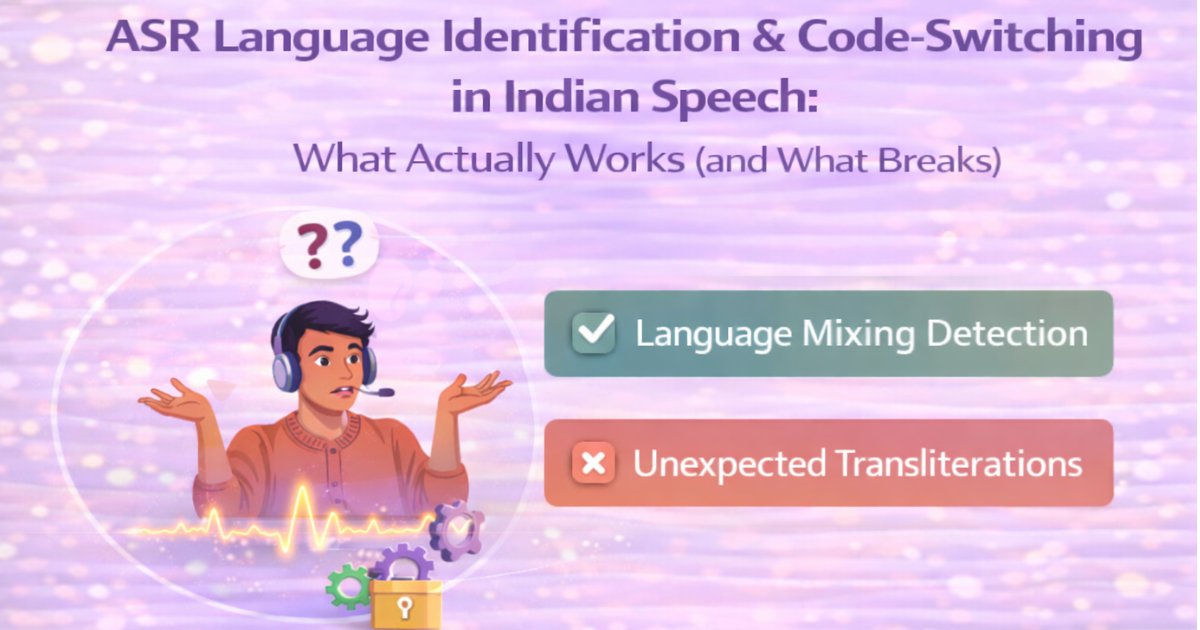
If you’ve ever listened to real Indian speech, actual speech, not lab-recorded demo clips, you already know the truth: language boundaries here are messy.
A single sentence can start in Hindi, drift into English, borrow a Marathi phrase, and end with regional slang that no dictionary ever agreed on. That’s everyday India. And for ASR systems, this is where things get interesting and difficult.
At FonadaLabs, we build ASR for real usage, not sanitized examples. So let’s talk honestly about language identification, code-switching, and how Indian speech behaves in production systems.
The Reality of Language Identification in Indian ASR
In theory, language identification sounds simple:
detect the language → transcribe → done.
In practice, Indian speech challenges that assumption immediately.
Speakers switch languages mid-thought. Pronunciations carry strong regional accents. English words are spoken with phonetics borrowed from Hindi, Tamil, Bengali, or Telugu. Even within the same language, dialects can vary drastically.
This is why explicit language control matters.
At FonadaLabs, our ASR API requires a language_id parameter. That’s intentional. It avoids guesswork and keeps transcription reliable, especially in multilingual environments where automatic detection can easily go wrong.
We currently support 22 Indian languages, each optimized for regional accents and speaking styles. When the language is defined clearly, the system can focus on accuracy instead of making risky assumptions.
Code-Switching: The Indian Default, Not the Edge Case
Code-switching isn’t an “advanced feature” for Indian speech. It’s the default.
People don’t consciously switch languages; they just talk.
From an ASR perspective, this creates two hard problems:
Phonetic overlap: English words spoken with Indian phonetics often resemble native vocabulary sounds.
Context ambiguity: The same word can belong to different languages depending on usage.
Instead of pretending this problem doesn’t exist, we design our systems around real speech behavior. Our ASR models are trained on diverse datasets spanning languages, accents, and speaking styles across India, which helps maintain transcription quality even when speech isn’t linguistically “clean.”
The result isn’t magic, it’s consistency. And consistency matters more than clever guesses.
Real-Time vs Batch: Why Language Handling Feels Different
Language handling behaves differently depending on how ASR is deployed.
In real-time streaming, latency is critical. The system must process audio in small chunks and return results quickly. That leaves less room for mid-stream correction.
In batch transcription, the full audio context is available. This allows the ASR engine to stabilize output across longer speech segments.
FonadaLabs supports both real-time and batch transcription, letting developers choose what fits their use case live applications like voice assistants, or offline audio analysis like call recordings and subtitles.
Why Language Accuracy Isn’t Just About Words
Language accuracy isn’t only about getting the sentence right. It impacts everything downstream.
Word-level timestamps enable:
Real-time subtitles
Voice analytics
Searchable transcripts
Smarter NLP pipelines
That’s why our ASR responses include timing information; preprocessing, inference, decoding, and total latency, so developers can understand performance, not just text output.
The Boring Stuff That Actually Improves Results
Here’s the unglamorous truth:
most ASR failures aren’t caused by models, they’re caused by input quality.
That’s why we strongly recommend:
Clear audio
Minimal background noise
Proper sample rates (16kHz+)
Controlled speaking pace
Reduced overlapping speech
These basics matter more than most “AI tricks” people advertise.
Why We Built FonadaLabs ASR the Way We Did
At FonadaLabs, we didn’t aim to build a flashy demo.
We built an ASR system that developers can actually deploy.
REST APIs that are simple and predictable
SDKs that support streaming and batch workflows
Broad Indian language coverage
Support for real-world accents and audio formats
Low-latency transcription with transparent performance metrics
We focus on doing the fundamentals right, because in Indian speech recognition, fundamentals decide whether a system survives production.
Final Thoughts
Indian speech doesn’t follow rules, and ASR systems shouldn’t pretend it does.
Language identification and code-switching are hard problems, not checkbox features. Handling them responsibly means respecting linguistic diversity, reducing assumptions, and giving developers control.
That’s exactly how we approach ASR at FonadaLabs:
grounded, transparent, and built for how people actually speak.
If you’re building voice-enabled applications for India, that difference shows up very quickly right where it matters most: in production.