
How to Measure Speech Recognition Quality for Chatbots and AI
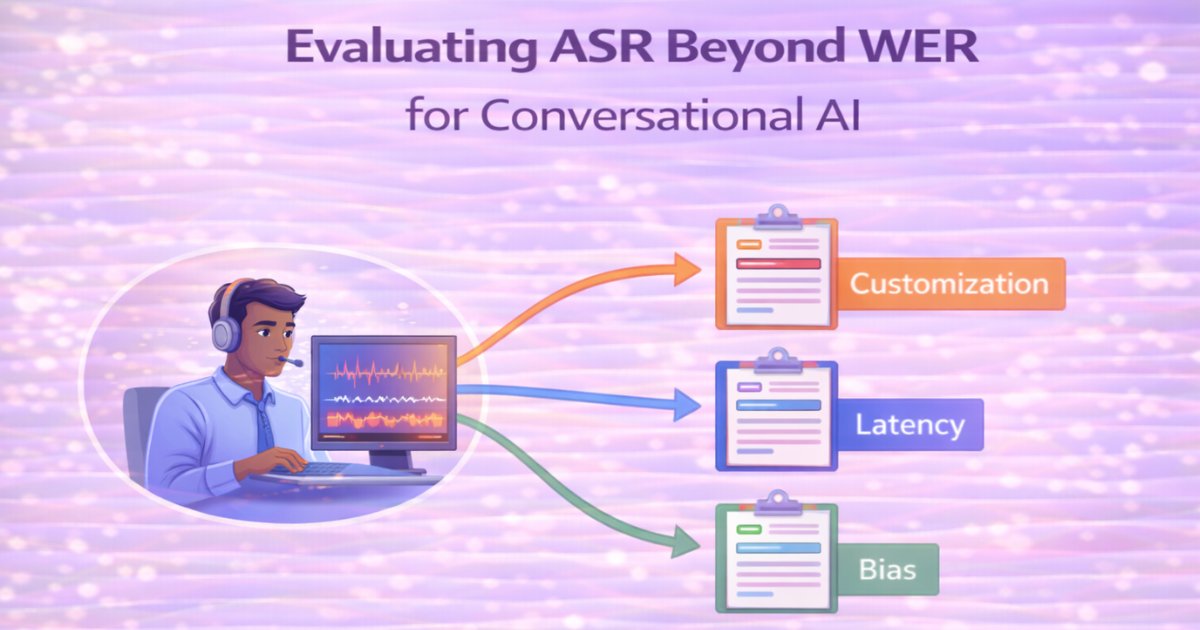
Word Error Rate (WER) is the industry standard for measuring ASR quality. It's simple, objective, and easy to compare.
It's also increasingly useless for conversational AI.
WER measures how many words you got wrong. But in conversational AI, what matters is whether the system understood intent and responded appropriately. Perfect WER that misses meaning is worse than errors that capture intent correctly.
The problem in action:
User: "Can you schedule a meeting for next Tuesday?"
Transcript A (0% WER): "Can you schedule a meeting for next Tuesday?"
Transcript B (14% WER): "Can you shedule a meating for next Tuesay?"
Transcript C (7% WER): "Can you schedule a meeting for next Thursday?"
WER says A is perfect, B is terrible, C is okay. But for conversational AI: A and B convey identical intent (both work perfectly), while C is catastrophic (wrong day, task fails). WER treats all word errors equally. In conversational AI, some errors matter immensely while others are irrelevant.
Why WER Breaks for Conversational AI
WER was designed for transcription services where humans read the output. Every word mattered. But conversational AI uses transcripts as intermediate data. What matters is whether downstream systems (intent classifiers, entity extractors) work effectively.
Where WER fails:
Orthographic errors: "Its" vs "it's," "their" vs "there" increase WER, rarely affect intent.
Punctuation/capitalization: WER counts these as errors. Conversational AI normalizes or ignores them.
Disfluencies: "I want to, uh, like, schedule a meeting." Should ASR transcribe "uh" and "like"? Including them doesn't help downstream processing. Excluding them makes WER comparison meaningless.
Semantic weight: "Tuesday" vs "Thursday" (one word) is catastrophic. "Please kindly" vs "" (two words) is fine. WER says the second is twice as bad.
Interruptions: "I want to sche... actually, can you set up a meeting?" WER treats this as errors. Intent detection treats it as natural conversation.
Metrics That Actually Matter
Intent classification accuracy: Did ASR output allow correct intent identification? Compare intent accuracy on ASR transcripts vs perfect transcripts. The gap shows real application impact. An ASR with 15% WER but 94% intent accuracy beats one with 10% WER but 85% intent accuracy: fewer transcription errors but more intent misunderstanding.
Entity extraction F1: Getting entities right is critical. "Tuesday" vs "Thursday" has minimal WER difference but catastrophic entity error. Measure precision (extracted entities that are correct) and recall (actual entities extracted correctly). Weight by criticality: account numbers are mission-critical, names important, greetings irrelevant. Example: "Transfer $500 to account 12345" transcribed as "...account 12245" has 11% WER but 100% entity error. Looks acceptable, functionally catastrophic.
Dialogue success rate: The ultimate metric: did the conversation succeed? Run full dialogues with ASR transcripts, measure task completion. Captures everything: ASR quality, intent understanding, entity extraction, dialogue management, UX. Example: Appointment booking success drops from 92% (perfect transcripts) to 78% (ASR) = 14-point ASR-induced failure rate. Hard to measure but the only end-to-end realistic metric.
Semantic similarity: Instead of word-level errors, measure semantic similarity using sentence embeddings (BERT, sentence-transformers). "Can you shedule a meating" vs "Could you set up a meeting" both score high similarity despite spelling errors and different wording. Meaning preserved. More aligned with conversational AI needs but less interpretable and doesn't capture entity-level accuracy.
Latency: Speed matters. Real-time factor (RTF): processing time / audio duration. RTF < 1.0 = faster than real-time (good). End-to-end latency targets: <500ms responsive, <1000ms acceptable, >1500ms poor. Measure P95/P99, not just averages. A 200ms average with 3-second P99 feels broken. Users tolerate minor errors to maintain conversational flow better than perfect transcripts with 2-second latency.
Error recovery: Can the system recover from mistakes? Clarification success rate (system asks for clarification, user rephrases successfully), implicit recovery (system guesses and gets it right), explicit failure. A system with occasional errors but good recovery beats one with fewer errors but poor recovery.
User experience: Repetition rate (how often users repeat themselves, frustrating even if eventual transcription works), rephrasing rate (users speaking unnaturally like "SCHEDULE... MEETING... TUESDAY"), task abandonment (users give up completely, harshest metric), satisfaction scores (direct but sometimes biased).
Domain-Specific Priorities
Voice assistants: Intent accuracy, entity accuracy (searches/timers/reminders), latency (<300ms), wake word rates. Perfect transcription less critical, users never see it.
Customer support bots: Entity extraction (account numbers, order IDs, dates), dialogue success, escalation rate, satisfaction. Speed less critical, users accept 1-2s latency for accuracy.
Medical dictation: Medical terminology accuracy, proper nouns (patient/medication names), entities (dosages/dates/measurements), perfect transcription (doctors read and sign). Latency less critical, batch processing acceptable.
Call center analytics: Speaker diarization (who said what), keyword spotting (compliance terms), sentiment detection, topic classification. Perfect transcription less critical, human QA reviews key moments. Real-time speed less critical, can process after call.
Building Better Evaluation
Comprehensive ASR evaluation for conversational AI needs:
Traditional metrics (baseline comparison): WER, CER, latency
Task-specific metrics (application relevance): Intent accuracy, entity F1, dialogue success
User experience metrics (real-world performance): Repetition rate, abandonment, satisfaction
Error analysis (improvement insights): Error types, critical vs non-critical words, distribution by accent/audio quality/use case
Edge case testing (robustness): Noisy environments, accented speech, fast/slow speech, out-of-vocabulary words, domain terminology
Production evaluation is essential: A/B testing on real traffic (measure actual impact on user success), shadow mode (run new ASR in parallel without affecting users), user feedback loops (track which errors users correct vs ignore, indicates importance), cohort analysis (measure performance across segments like native vs non-native speakers, age groups, use cases).
The Bottom Line
WER is easy to measure and compare. That's its strength and its weakness. For conversational AI, we need metrics matching what we actually care about: Can users accomplish goals? Does the system understand intent? Are critical entities captured? Is the experience fast enough to feel natural? Do users repeat themselves or speak unnaturally?
These metrics are harder. They require running real conversations, collecting feedback, analyzing task success. But they tell you what matters: whether your conversational AI actually works.
A system with 20% WER that users love beats one with 5% WER that users abandon. Build for the right metrics. Measure what matters. Remember that in conversational AI, the transcript is never the goal. Understanding and helping users is.
WER tells you how accurate your ASR is. Only user success tells you how good your conversational AI is. And that's what actually matters.
FonadaLabs understands ASR quality isn't just about Word Error Rate. Our systems are designed for production conversational AI: low latency for responsive interactions, strong accuracy for intent understanding, and robustness for diverse Indian speech patterns and accents. Supporting real-time streaming and batch processing optimized for actual constraints. ASR that enables successful conversations, not just accurate transcripts.