Building Low-Latency TTS Pipelines for Real-Time Voice Agents
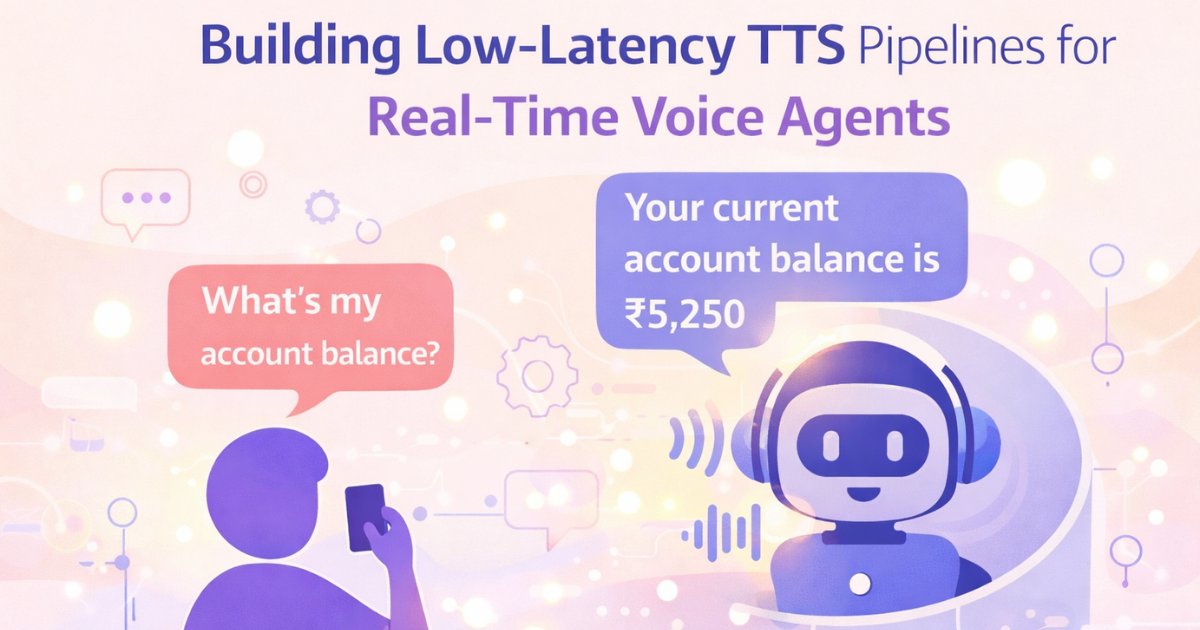
Picture this: You're speaking with a customer service voice agent, asking about your account balance. You finish your question and... wait. One second. Two seconds. Three seconds of awkward silence before the robotic voice finally responds. Frustrating, isn't it? Now imagine the same conversation, but the voice agent responds instantly, so naturally that you forget you're talking to a machine.
This is the difference between a standard TTS system and a low-latency TTS pipeline optimized for real-time voice agents. Let's explore how to build TTS pipelines that flow like natural conversation.
Why Latency Matters in Voice Agents
The Human Expectation: In natural conversation, responses typically begin within 200-300 milliseconds. When delays exceed 500ms, conversations start feeling awkward. Beyond 1000ms (1 second), users perceive significant lag, leading to frustration and disengagement.
The Business Impact: High latency translates directly to poor user experience. Customers hang up. Satisfaction scores drop. Studies show that every 100ms of additional latency can reduce user engagement by up to 7%. Your beautifully designed conversational AI becomes unusable simply because it can't keep pace with human conversation speed.
Understanding the Latency Budget: A typical voice interaction involves Speech Recognition (200-500ms), Intent Processing (100-300ms), Text-to-Speech Generation (500-3000ms in traditional systems), Network Transmission (50-200ms), and Audio Playback Buffer (50-100ms). In poorly optimized systems, this exceeds 4-5 seconds. In well-optimized systems, total time drops to under 1 second.
The Architecture of Low-Latency TTS
1. Streaming Instead of Batch Processing
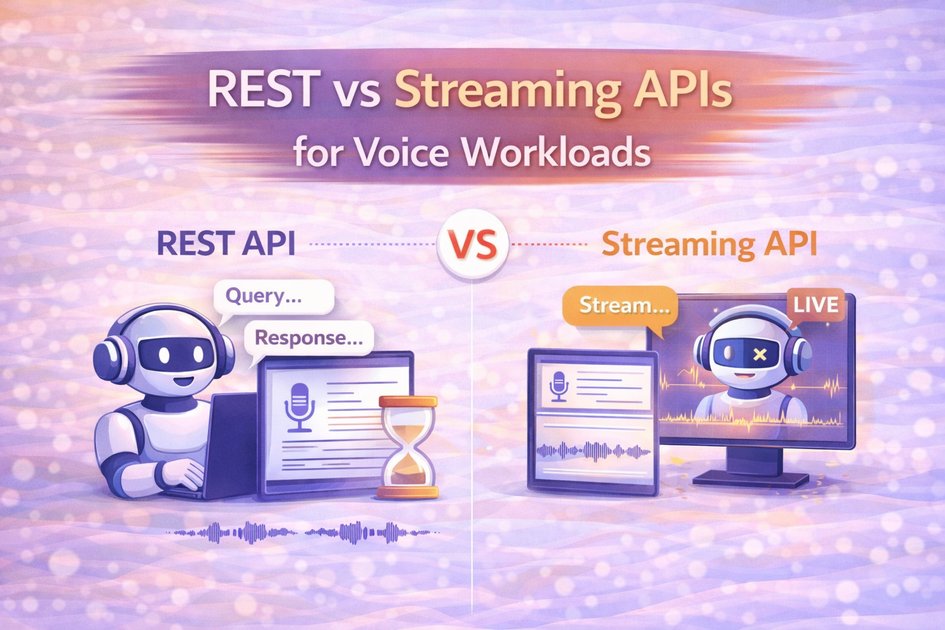
Traditional Approach: Generate entire sentence → Wait for completion → Play audio (2-3 seconds)
Streaming Approach: Generate in small chunks → Start playing immediately → Continue generating
Think of it like streaming a video; you don't wait to download the entire movie before watching. Similarly, streaming TTS starts producing audio as soon as it processes the first few words. The model generates mel-spectrograms in small windows covering 1-2 words, immediately passing them to the vocoder. While the first chunk plays, the next chunk generates, creating a continuous stream.
2. Optimized Model Architecture
Non-Autoregressive Models: Traditional models generate audio sample-by-sample, which is slow. Modern systems use models like FastSpeech that predict the entire acoustic sequence in parallel, achieving 10-50x speedup.
Lightweight Vocoders: Low-latency systems use optimized vocoders like MelGAN or HiFi-GAN, specifically designed to generate high-quality audio with minimal computational cost, processing audio much faster than real-time.
Model Quantization: Converting model weights from 32-bit to 8-bit reduces model size by 4x and speeds up inference by 2-4x with minimal quality loss, crucial for handling high concurrent requests.
3. Smart Text Chunking
Sentence-Aware Chunking: Break at natural boundaries rather than arbitrary word counts. "Hello, how can I help you today?" should be chunked as "Hello," + "how can I help you today?"
Predictive Chunking: Anticipate common phrases and pre-generate them. If a user asks "What's my balance?", start generating "Your current balance is..." while fetching the actual balance from the database.
Dynamic Chunk Sizing: Adjust chunk size based on network conditions and processing capacity to maintain responsiveness.
4. Pipeline Optimization
GPU Utilization: Use batching to process multiple requests simultaneously without increasing individual latency. Modern inference servers can batch multiple requests together, significantly improving throughput.
Caching Strategies: Cache commonly spoken phrases, numbers, dates, and responses. "Your account balance is" might be spoken thousands of times daily, generate it once, reuse forever.
Advanced Techniques
Speculative Generation: Start generating audio before complete text is available. If the system is confident about next words, begin synthesis speculatively, most of the time, you've saved precious milliseconds.
Adaptive Quality: Implement quality adjustment based on latency requirements. For critical speed scenarios, use a faster model. For less time-sensitive parts, switch to higher quality.
Edge Deployment: Deploy TTS models closer to users, on edge servers or on-device for mobile applications. This eliminates network latency entirely.
Real-World Implementation
User Says: "What's my account balance?"
Processing Flow: ASR completes including noise cancellation → Intent recognized → Database query initiated → Meanwhile, TTS starts generating: "Your current account balance is..." → First audio chunk ready → User starts hearing response immediately → Database returns balance → TTS generates the amount → Continuous streaming maintains natural flow.
Result: Minimal perceived latency. Conversation feels natural and responsive, comparable to human interaction.
Implementation Best Practices
Monitoring & Metrics: Track P50, P95, and P99 latency (not just averages). Monitor time-to-first-byte (TTFB), total generation time, and buffer underruns.
Graceful Degradation: When load increases, intelligently degrade service rather than failing. Queue requests, use simpler models, or increase chunk sizes, but keep the system responsive.
Testing Under Load: Test with realistic concurrent users. Load test with 2-3x expected peak traffic.
Error Handling: Implement retry logic, fallback models, and graceful error messages that maintain conversation flow.
FonadaLabs TTS: Built for Real-Time
FonadaLabs TTS is engineered specifically for low-latency, real-time applications. The system is optimized for streaming architecture, delivering responsive performance while maintaining natural voice quality across English, Hindi, Tamil, and Telugu.
The architecture leverages lightweight neural models designed for speed without compromising naturalness. Support for streaming output means your voice agents can start speaking immediately, creating fluid conversations. Whether you're building customer support bots, voice-enabled banking, healthcare assistants, or interactive educational tools, FonadaLabs provides the responsiveness modern users expect.
Key Capabilities: Low time-to-first-audio, true streaming synthesis, production-grade quality at scale, multi-language support optimized for real-time use, and efficient resource utilization enabling high concurrent requests.
Conclusion
Building low-latency TTS pipelines requires understanding the entire system holistically, from model architecture to network optimization, from intelligent chunking to graceful error handling. The reward? Voice agents that feel genuinely conversational, natural, and responsive.
As voice interfaces become increasingly prevalent, the ability to deliver instantaneous, natural speech synthesis becomes a competitive differentiator. The future of voice AI isn't just about what agents can say, but how quickly and naturally they can say it. With the right architecture and tools like FonadaLabs TTS, building voice agents that feel truly human is achievable today.
Because in real-time conversation, every millisecond matters, and silence is not golden.