
Why Noise Reduction Can Lower Speech-to-Text Accuracy
The Paradox of Perfect Silence
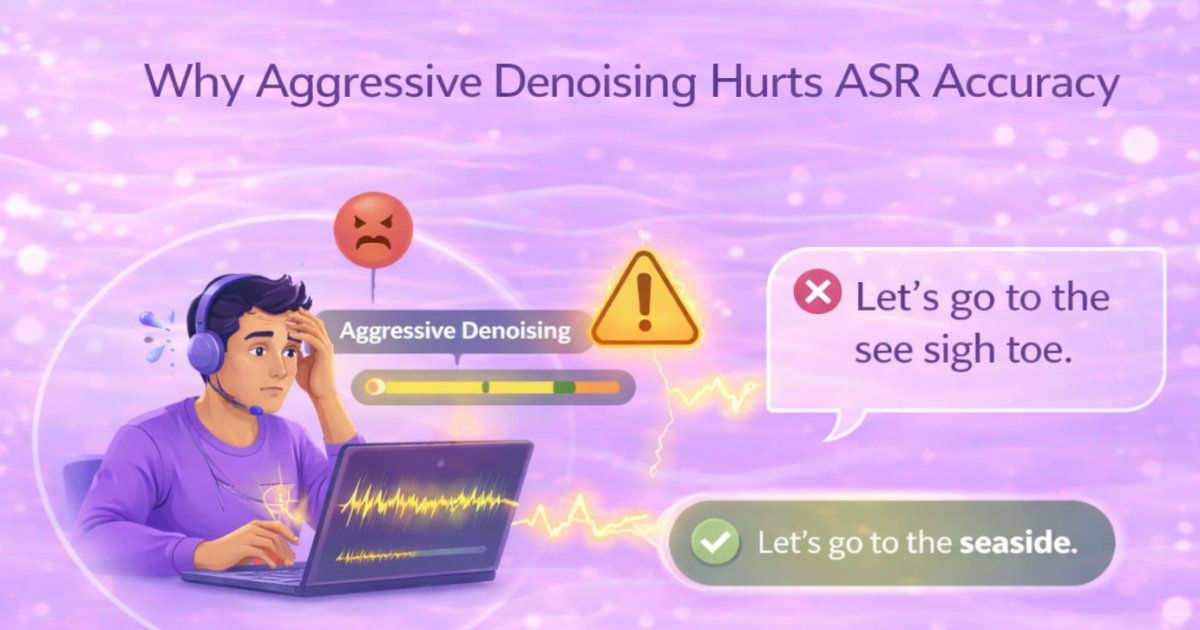
Here is a truth about audio that surprises a lot of audio engineers: making the audio sound really good can actually make it harder for computers to understand the audio. When you remove a lot of noise from the audio it sounds better to people. It can cause problems, for Automatic Speech Recognition systems. The Automatic Speech Recognition systems have difficult time understanding the audio when it is too clean.
It's not a bug. There is an essential conflict between the retention of information and perceptual quality. Let's examine why your painstakingly denoised audio may be interfering with your speech recognition system.
The Information Loss Problem: When Clean Becomes Corrupt
Signal Distortion: Throwing the Baby Out with the Bathwater
It is impossible for aggressive denoising algorithms to discriminate between speech and noise when they are in the same frequency range. You will unavoidably begin to harm the speech signal itself as you increase the suppression.
Human speech spans approximately 300 Hz to 8 kHz, with crucial information concentrated in the 1-4 kHz range. This is known as the spectral overlap issue. Sadly, a lot of everyday sounds, such as typing on a keyboard, rustling paper, and HVAC systems, reside in the same frequency ranges. An aggressive filter suppresses both high-frequency noise and fricative consonants like "s" and "f" because it is unable to distinguish between the two.
The result? Consonants get softened or eliminated entirely. And here's the kicker: consonants carry most of the intelligibility in speech. The difference between "cat" and "hat" is entirely in that initial consonant. Remove it, and even humans struggle, let alone machines.
Musical Noise: The Artifact That Confuses Everything
When spectral subtraction gets too aggressive, it creates "musical noise." Those characteristic chirping and bubbling artifacts. To human ears, these are merely annoying. To ASR systems, they're catastrophic.
Why? ASR models are trained on relatively clean speech or carefully controlled noisy conditions. They've never seen the bizarre spectral patterns that musical noise creates. These artifacts don't sound like speech, they don't sound like natural noise, they sound like nothing the model has encountered before. The acoustic model gets confused, and accuracy plummets.
The Temporal Structure Catastrophe
Frame-Level Processing: Destroying Continuity
Most denoising systems operate frame by frame (10-20ms chunks). Each frame is processed independently, with gain masks applied based on instantaneous spectral estimates. This works okay for human perception because we're good at mentally smoothing over discontinuities.
ASR systems? Not so much.
Temporal context is crucial for speech recognition. A phoneme's acoustic characteristics flow naturally from one to the next. These organic transitions can be broken by aggressive frame-by-frame processing, which can produce abrupt discontinuities at frame borders.
When you say "stress," your mouth is already getting ready to make the "tr" sound while you're making the "s" sound. This is known as the coarticulation problem. ASR models rely on the smooth spectral transitions produced by this coarticulation as essential cues. These transitions can be broken by aggressive denoising, which can introduce artificial boundaries where they do not exist or leave phoneme boundaries unclear.
Onset and Offset Smearing
The beginning and ending of speech segments (onsets and offsets) are critical for ASR. They help the system segment continuous speech into discrete units. Aggressive denoising often applies attack and release smoothing to avoid clicks and pops, which can smear these critical boundaries.
When a word starts or ends becomes uncertain. Is that the beginning of a new phoneme or just the denoiser ramping up? The ASR system has to guess, and guesses lead to errors.
Feature Extraction Mismatch: Training vs. Reality
The Domain Shift Problem
Here's where things get really problematic. The majority of contemporary ASR systems are trained using certain acoustic characteristics, such as filter banks, raw waveforms with learned representations, or MFCCs (Mel-Frequency Cepstral Coefficients).
Audio with specific statistical qualities is used to extract these features. Aggressively denoising changes those statistics in a fundamental way.
MFCC Distortion: The vocal tract shape is represented by the spectral envelope of speech, which is captured by MFCCs. The cepstral domain may be distorted by aggressive spectral subtraction, which can produce negative values in the power spectrum (usually floored at zero). The MFCCs that are produced do not correspond to the model's expectations.
Dynamic Range Compression: Automatic compression or gain control is used by many denoisers. Although this sounds fantastic, it narrows the dynamic range that ASR models utilise to differentiate between loud and soft phonemes, as well as stressed and unstressed syllables.
Spectral Envelope Warping: Aggressive filtering can alter the relative amplitudes of formants (the resonant frequencies that define vowel sounds). If the denoiser attenuates the second formant more than the first, a vowel might look like a different vowel to the ASR system.
The Comfort Noise Conundrum
In order to prevent the unnatural feeling of total silence during pauses, many denoisers introduce "comfort noise." The statistical characteristics of this artificial noise differ significantly from those of natural background noise. These artificial patterns can confuse ASR models trained on real-world audio, even though they are undetectable to humans.
The model may have trouble identifying real speech onsets against the artificial background, or it may perceive the comfort noise as very quiet speech, resulting in false insertions (hallucinated words).
The Prosody and Suprasegmental Information Loss
Energy Contours: The Missing Emphasis
Speech is more than just a string of phonemes. Important information is conveyed through prosody, which consists of rhythm, stress, and intonation. Important words are emphasised by lengthening and increasing their volume. Energy contours are used by ASR systems to pinpoint important content words and stressed syllables.
These energy differences can be flattened by aggressive denoising, particularly when dynamic gain control is used. All of a sudden, the energy of each syllable is the same, and the ASR system loses a crucial clue for understanding sentence structure and recognising keywords.
Pitch and Harmonics: Tonal Languages Beware
For tonal languages (Mandarin, Vietnamese, Thai), pitch contours are phonemic. The same syllable with different tones means completely different things. Some aggressive denoisers can distort pitch estimation or attenuate harmonics unevenly, corrupting tonal information.
Even for non-tonal languages, pitch helps with speaker identification, emotion detection, and question vs. statement distinction. Over-processing can blur these distinctions.
The Neural Network Robustness Reality Check
Modern ASR is Already Noise-Robust... Sort Of
Here's an important consideration: modern deep learning based ASR systems (like those using Transformers or RNN-Transducers) are actually quite good at handling noise. But only noise they've seen during training.
Training data for commercial ASR systems includes clean speech, speech with various natural background noises, speech in different acoustic environments, and multiple accents and speaking styles.
What's typically NOT included? Speech that's been through aggressive denoising with all its associated artifacts. So you're introducing a type of distortion the model has never encountered.
The Overfitting to Clean Speech Problem: If you train an ASR model primarily on clean or lightly processed audio, then deploy it on heavily denoised audio, you've created a train-test mismatch. The model's acoustic understanding doesn't transfer.
The Sweet Spot: Gentle Enhancement, Not Aggressive Suppression
So what's the solution? The key is to optimize for ASR performance, not human perceptual quality.
Conservative Noise Reduction Strategies
Adaptive Suppression: Use gentler suppression levels, even if some noise remains audible. Aim for 6-10 dB noise reduction rather than 20+ dB. The goal is to improve SNR without destroying speech structure.
Frequency-Selective Processing: Be more aggressive in frequency regions where speech has little energy (below 200 Hz, above 6 kHz for narrowband) and extremely conservative in the critical 1-4 kHz range where most consonant information lives.
Voice Activity Detection (VAD) First: Use robust VAD to identify speech vs. non-speech regions. Apply heavier processing only during non-speech segments. During speech, apply minimal or no suppression.
Training with Augmentation
If you control the ASR model training, include denoised audio in your training set. Apply the same denoising algorithm you'll use in production to a portion of your training data. This teaches the model to handle denoising artifacts.
Better yet, use multi-condition training. Expose the model to both raw noisy audio and various levels of denoised audio. This builds robustness to both noise and denoising artifacts.
Real-World Examples: When Less is More
Case Study: The Call Center Catastrophe
A major call center deployed aggressive noise cancellation to improve customer experience. Human satisfaction increased, but their automated transcription accuracy dropped by 12%. Why? The denoiser was removing the high-frequency consonants that distinguished similar-sounding product names. They rolled back to gentler processing and accuracy recovered. If you're working on handling noisy call center audio, this balance is critical.
Case Study: The Smart Speaker Struggle
Early smart speakers applied heavy signal processing to make responses sound crisp and clear. But this same processing, when applied to user commands, degraded far-field ASR accuracy. Modern devices use separate processing chains: gentle enhancement for ASR input, more aggressive enhancement for speaker output.
Case Study: The Medical Dictation Dilemma
A medical transcription service found that doctors recording in noisy clinics had better ASR accuracy with minimal denoising compared to aggressive suppression. The reason? Medical terminology includes many similar-sounding words distinguished only by subtle consonants. Aggressive denoising blurred these distinctions.
Conclusion: Optimize for Your Objective
The fundamental lesson is this: optimize your audio processing for your actual objective. If your goal is human listening pleasure, aggressive denoising might be appropriate. If your goal is ASR accuracy, gentle enhancement with careful preservation of speech structure is the way to go.
The best audio for ASR isn't the cleanest audio. It's the audio that preserves the maximum amount of discriminative information, even if that means tolerating some background noise. Sometimes the messier signal is the more informative one.
This becomes especially important when dealing with complex acoustic environments where traditional noise cancellation struggles. Whether you're building ASR for Indian languages or working on accent robustness, preserving speech characteristics should always be your priority over achieving perfect silence.
Intelligent Noise Cancellation for ASR Pipelines
At Fonadalabs, we understand this delicate balance. Our AI-powered noise cancellation API uses advanced deep learning models (DeepFilterNet + CMGAN) that are specifically designed to preserve speech characteristics while removing background noise. Unlike aggressive traditional denoising, our models are trained on millions of hours of audio to intelligently separate speech from noise without introducing artifacts that confuse ASR systems.
Whether you're building speech-to-text applications, voice assistants, or transcription services, our API provides the right level of enhancement. With support for multiple processing methods (full file denoising, chunk-based processing, or WebSocket streaming), you can integrate optimal noise cancellation that improves both perceptual quality and ASR accuracy. Learn more about evaluating ASR performance beyond just WER to understand how noise handling impacts overall system quality.