
How to Improve Speech Recognition for Indian Accents
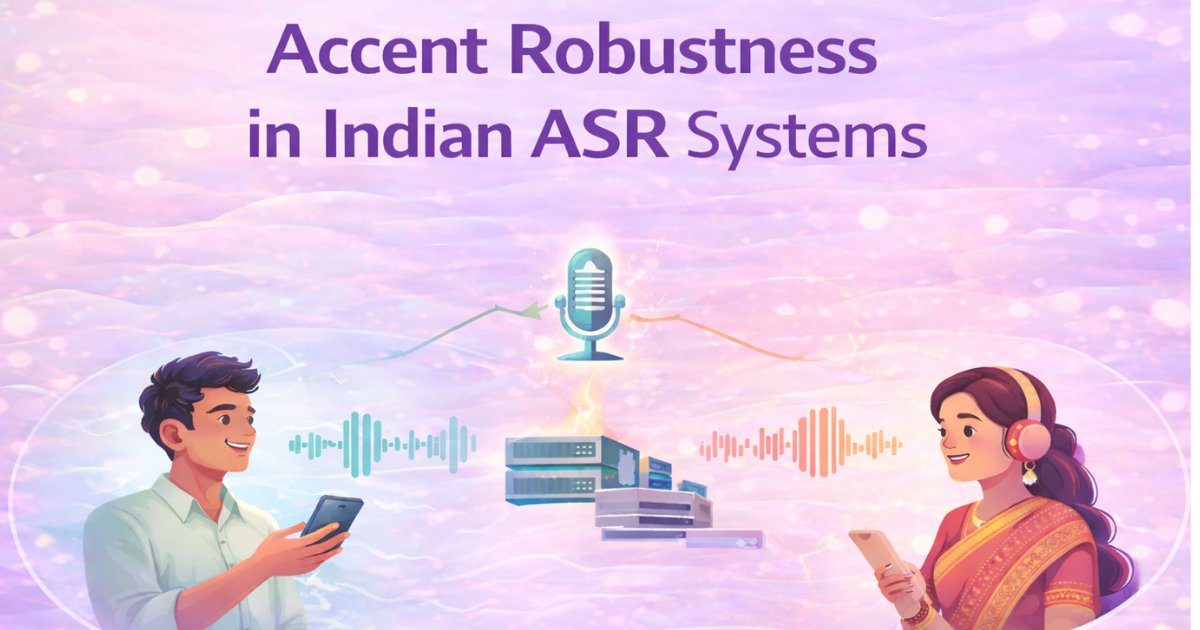
If you've ever used a voice assistant that understood your American colleague perfectly but looked completely lost when you spoke, welcome to the accent problem.
Here's the thing: accents aren't errors. They're not "incorrect" ways of speaking. They're what happens when language meets geography, community, education, mother tongue, and personal history. But for ASR systems trained on standardized speech, accents might as well be alien transmissions.
In India, this problem goes from hard to "are you kidding me?" hard. We're not talking about cute regional variations of one language. We're talking 22 official languages, hundreds of dialects, and millions of people who casually switch languages mid-sentence like it's nothing. The way someone from Kerala speaks Hindi differs from Delhi Hindi, which differs from Kolkata Hindi. And that's just one language.
Building ASR that works for actual Indian speech isn't about collecting more data. It's about understanding why accents exist, how they mess with speech patterns, and designing systems that treat variation as normal rather than some annoying edge case.
Why Accents Destroy ASR Systems
Most ASR models train on "clean" data, native speakers with neutral accents in quiet rooms. This creates a blind spot the size of Maharashtra: the model learns an idealized version of language that barely exists in reality.
When someone with a strong regional accent speaks, everything breaks:
Phonetic substitution: Tamil speakers might say "w" instead of "v" because Tamil doesn't have a /v/ sound. The ASR model, trained on native English speakers, has no idea these are the same word.
Prosody chaos: Rhythm, stress, and intonation transfer from native languages. Hindi speakers stress syllables differently in English. Telugu speakers use different pitch patterns. Models expecting specific rhythms just... freeze.
Code-mixing mayhem: Indians don't just switch languages. We blend them. "Main kal office jaa raha hoon" mixes Hindi and English naturally. Standard ASR models expect language boundaries, not language smoothies.
Speed roulette: Regional accents change pacing. Some Indian English speakers go faster, some slower, some pause differently. Models trained on consistent rhythm can't keep up.
Vowel and consonant adventures: "Come" sounds wildly different between Punjab and Tamil Nadu. Consonants get retroflex, aspirated, or softened in ways the training data never saw.
Result? The system either spits out garbage or gives up. Users get frustrated, speak like robots, or ditch voice features entirely.
The Data Problem: More ≠ Better
The obvious fix seems simple: collect speech from people with different accents. Done!
Not even close.
Volume ≠ diversity: You can grab 10,000 hours of Indian speech, but if it's all urban, English-educated tech workers, you've just collected 10,000 hours of the same accent. Real diversity means hunting down speakers from different regions, educational backgrounds, age groups, and linguistic communities.
Imbalanced representation: Some accents dominate datasets because those speakers have better access to technology. Rural speakers, older speakers, and speakers of less common languages get systematically ignored. The model then crushes it for urban users and fails spectacularly for everyone else.
Annotation bias: Transcribers bring their own biases. Hearing an unfamiliar accent, they "correct" it to what they think was meant, not what was actually said. Training data ends up reinforcing standard pronunciation instead of accepting variation.
Language evolves: Accents shift. New code-mixing patterns emerge. A 2020 dataset misses 2025 trends. Models on static datasets become less robust unless continuously updated.
Architectural Solutions
Building accent-robust ASR requires architectural decisions that embrace variation:
Multi-accent training: Train specialized models for different accent clusters; South Indian, North Indian, East Indian. Route audio to the right model or ensemble multiple models. Each specializes brilliantly, but maintaining multiple models is operationally messy.
Accent adaptation layers: Keep a core model, add lightweight layers that fine-tune for specific accents. The base handles universal features, adaptation layers handle accent quirks. Less data needed, but assumes accents are simple variations (they're not always).
Phonetic flexibility: Train models to recognize phonetic similarity, not exact pronunciations. If someone says "berry" meaning "very," the model gets it. Requires understanding phonetic relationships and probabilistic substitution patterns.
Context-aware correction: Use language models to post-process. If the acoustic model outputs "I went to the berry shop" but context suggests "very good," fix it. Works for common substitutions but can over-correct when the speaker actually meant "berry."
Continuous learning: When users correct errors, feed corrections back into the model. The system learns user base accent patterns over time. Powerful, but needs robust feedback loops and privacy protection.
Code-Mixing: India's Special Boss Level
Code-mixing intersects with accents in ways that break standard assumptions. "Main kal office jaa raha hoon" mixes Hindi and English, and both are influenced by the speaker's native tongue.
Standard ASR assumes one language per utterance, clear boundaries, consistent pronunciation. None of this holds in Indian speech.
Intra-sentence switching: People switch languages mid-sentence without warning. ASR must detect switches on the fly, maintain separate language models, and handle transitions smoothly. Plus, English words in Hindi sentences sound different from English words in English sentences.
Transliteration chaos: "Main tumhe kal call karunga": do you transcribe "call" or "कॉल"? Both are correct. Which do you pick?
Accent transfer: Code-mixing means accents in the second language get influenced by the first. A Gujarati speaker mixing English into Hindi has Gujarati phonetic patterns affecting both.
Solving this requires multilingual models that understand how languages interact in Indian speech communities.
Measuring Robustness: WER Isn't Enough
Word Error Rate (WER) measures how many words got transcribed wrong. But WER hides bias.
A system might show 5% WER overall but 25% for rural speakers. It might nail Mumbai English and bomb on Northeast Indian English. Aggregate metrics lie.
Better metrics:
Stratified WER: Break down errors by accent, region, age, language background
Phonetic confusion matrices: Track which sounds get confused (if /v/ always becomes /w/ for Tamil speakers, fix that specific pattern)
Code-mixing accuracy: Measure language switch detection and accuracy across boundaries
Subjective usability: Track user corrections and satisfaction, not just technical accuracy
Real-World Deployment Headaches
Even perfect models face deployment problems:
Latency vs accuracy: More robust models are larger and slower. Real-time apps force a choice between accent robustness and acceptable latency.
Long-tail accents: Hundreds of linguistic communities exist. Some accents are too rare for good training data. Serve them poorly or invest disproportionate resources?
User adaptation burden: When the system doesn't understand, users adapt, speak slower, enunciate, switch languages. This feels like failure even if it eventually works.
Bias amplification: Poor performance for certain accents means those users quit voice features. Less data means the model doesn't improve. The gap widens.
Where FonadaLabs Fits In
At FonadaLabs, we built our ASR specifically for Indian speech from scratch. Not a generic model "adapted" for India, designed for how Indians actually speak.
We support 22 languages optimized for regional accents and dialects. Hindi with a South Indian accent? English with North Indian phonetics? Natural code-mixing? The system handles it without forcing unnatural speech.
The goal: people shouldn't change how they speak to be understood. Technology should adapt to them.
The Path Forward
Accent robustness isn't a one-time fix. It's an ongoing commitment to inclusive technology.
The best ASR systems don't just tolerate accents; they expect them. They're designed assuming variation is normal and standardization is fantasy.
This means:
Collecting genuinely diverse data, not just more data
Building architectures with phonetic flexibility
Measuring performance across user groups, not just overall
Continuously learning from real usage
Treating code-mixing as a feature, not a bug.
When ASR works for everyone regardless of accent, voice technology becomes truly accessible. Until then, we're building systems that work great for some people and spectacularly fail for others.
The question isn't whether Indian ASR should be accent-robust. It's whether it should work at all. Because if a system only works for neutral accents, it doesn't work for India.