
Audio Pre-Processing Pipelines for Voice Bots and IVR Systems: Engineering Robust Conversational AI
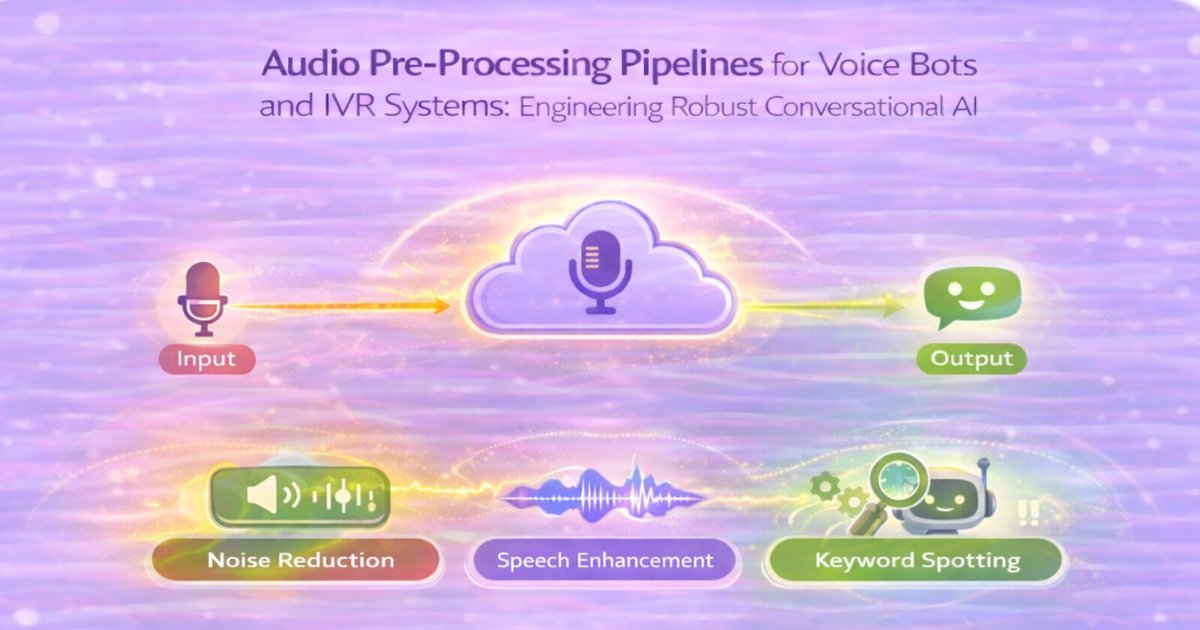
You call your bank's customer service. An AI voice greets you instantly. You say "Check my balance" while traffic rumbles outside, and it understands perfectly despite background noise, your accent, and room echo. The interaction feels seamless.
Behind that simplicity lies a sophisticated audio pre-processing pipeline. A series of carefully orchestrated signal processing steps transforms raw, messy audio into clean input that speech recognition can actually handle. Without this foundation, even the most advanced voice bot becomes useless.
Understanding how these pipelines work separates functional conversational AI from systems that constantly ask users to repeat themselves.
Why Pre-Processing Matters: The Raw Audio Reality
The Brutal Truth About Real-World Audio
Speech recognition engines expect relatively clean audio. Clear voice, minimal background noise, consistent volume, no echo or reverberation. What they actually receive creates a far more challenging problem.
Phone Call Audio
Codec compression artifacts from bandwidth-limited networks. Packet loss during transmission. Varying bitrates as network conditions change. Telephone bandwidth limitations restricting frequency content to 300 to 3400 Hz instead of full spectrum audio.
These constraints remove acoustic information critical for consonant recognition and speaker characteristics.
Mobile Environment Challenges
Traffic noise from surrounding vehicles. Wind hitting the microphone directly. People talking nearby during calls. Music playing in public spaces. Fabric rustling against the phone as users move.
Each source creates spectral interference that overlaps with speech frequencies.
Indoor Space Acoustics
Room echo and reverberation from reflective surfaces. HVAC systems producing steady hum. Keyboard typing during work-from-home calls. Multiple simultaneous speakers in open office environments.
These conditions create temporal smearing and additive noise that degrades speech clarity.
Hardware Variations
Input quality ranges from high-end microphones to decade-old feature phones with degraded capsules. Manufacturing tolerances create frequency response variations. Component aging changes acoustic characteristics over time.
Feed this raw audio directly to your ASR engine and watch accuracy plummet. A well-designed pre-processing pipeline means the difference between 95% accuracy and 60% accuracy.
The Standard Pipeline Architecture
The typical flow for voice bot and IVR systems follows this structure:
Raw Audio Input → Audio Normalization → Noise Reduction → Echo Cancellation → Voice Activity Detection → Feature Extraction → ASR Engine
Each stage addresses specific acoustic problems. Understanding these stages enables intelligent optimization for different deployment scenarios.
Stage One: Audio Normalization and Conditioning
Sample Rate Conversion
Audio arrives in various sample rates depending on source. 8 kHz for narrowband telephony. 16 kHz for wideband connections. 48 kHz for fullband recordings. ASR engines typically expect one specific rate, usually 16 kHz as the optimal balance between quality and computational cost.
Resampling requires anti-aliasing filters to prevent artifacts. Poor resampling introduces high-frequency noise that confuses acoustic models. Modern systems use polyphase filters or sinc interpolation for clean conversion without spectral contamination.
Bit Depth and Format Conversion
Audio might arrive as 8-bit µ-law (telephony standard), 16-bit PCM linear, or 32-bit floating point. Convert everything to consistent format, typically 16-bit signed integer or 32-bit float for processing.
µ-law compression uses logarithmic quantization optimized for speech. Decompressing to linear PCM enables standard signal processing operations.
Level Normalization Strategies
Different callers speak at wildly different volumes. Some whisper. Some shout. Most fall somewhere between. ASR needs consistent input levels for optimal feature extraction.
Peak Normalization
Scales audio so the loudest point hits a target level, typically -3 dB to -1 dB below full scale. Simple to implement but amplifies noise during quiet speech. Works poorly for dynamic content with wide level variations.
RMS Normalization
Scales based on average energy over time windows, providing more consistent perceived loudness. Better for speech than peak normalization but requires analyzing entire audio segments first, making it unsuitable for streaming applications.
Dynamic Range Compression
The gold standard for real-time systems. Gently brings up quiet passages while taming loud ones, maintaining natural dynamics while ensuring consistent levels.
Use fast attack times (5 to 10 milliseconds) to catch transients quickly. Moderate release times (50 to 100 milliseconds) prevent pumping artifacts. Ratio of 2:1 to 4:1 provides transparent compression for most speech.
High-Pass Filtering
Remove rumble and DC offset below 80 to 100 Hz. This frequency range contains no speech information but plenty of noise. Microphone handling bumps. Wind buffeting. Building vibrations. Electrical hum from power lines.
A simple second or fourth order Butterworth filter at 80 Hz removes this interference without affecting speech quality. The gentle rolloff prevents phase distortion in adjacent frequency bands.
Stage Two: Noise Reduction
The Central Processing Challenge
This stage determines whether conversational AI works in real environments or only in quiet studios. Clean speech from noisy audio without introducing artifacts that confuse acoustic models.
Spectral Subtraction Approaches
Works well for stationary noise like AC hum, fan noise, steady traffic. During non-speech periods, estimate the noise spectrum. Subtract this estimate from the signal spectrum during speech periods.
Effective for predictable noise but creates musical noise artifacts with aggressive settings. The residual noise sounds like random tones rather than smooth background noise, which can be more distracting than the original noise.
Wiener Filtering
Provides optimal noise reduction when you can estimate signal and noise power spectral densities. More sophisticated than spectral subtraction with fewer artifacts. Still assumes relatively stationary noise characteristics.
Calculates time-varying gains for each frequency band based on estimated signal-to-noise ratios. Frequencies dominated by noise get suppressed. Frequencies dominated by speech pass through relatively unchanged.
Deep Learning Models
Modern standard for production systems. RNNs, U-Nets, and Transformers learn to separate speech from noise through training on millions of examples. They handle non-stationary noise (keyboard clicks, doors slamming, people talking) far better than classical methods.
For IVR systems, deep learning models typically run server-side where computational resources aren't constrained. For voice bots on edge devices, you need lightweight models optimized for real-time inference.
Balancing Quality Against Latency
Aggressive noise reduction improves ASR accuracy in noisy environments but introduces tradeoffs:
Processing latency increases to 20 to 50 milliseconds for deep learning models with temporal context requirements. Can distort speech if too aggressive, paradoxically hurting accuracy. Increases computational load significantly.
Conservative noise reduction preserves speech quality but leaves more noise for ASR to handle. Modern ASR engines show increasing noise robustness, so sometimes gentle enhancement works better than aggressive suppression. Excessive denoising can actually reduce recognition accuracy.
Stage Three: Echo Cancellation
The Feedback Loop Problem
In IVR systems, the bot speaks (plays audio prompts), and those prompts can leak back into the user's microphone, especially on speakerphone. The ASR then "hears" its own output mixed with user speech, creating recognition errors.
Acoustic Echo Cancellation Implementation
AEC uses adaptive filters to model the echo path and subtract the echo from incoming signals. The filter continuously adapts because echo paths change as users move phones or room acoustics vary.
Adaptive Filter Algorithms
LMS (Least Mean Squares) and NLMS (Normalized LMS) algorithms provide computationally efficient adaptive filtering suitable for real-time echo cancellation. NLMS normalizes the adaptation step size by input signal power, improving convergence stability.
Double-Talk Detection
Identifies when both user and bot speak simultaneously. During double-talk, the adaptive filter stops updating because it can't distinguish echo from user speech. The filter relies on its current echo estimate rather than trying to adapt to corrupted reference signals.
Modern Implementation Techniques
Frequency-domain processing provides computational efficiency through FFT-based convolution. Multi-delay filters handle multiple echo paths from different acoustic reflections. Residual echo suppression uses spectral subtraction for remaining echo after adaptive cancellation.
Typical echo cancellation systems achieve 30 to 40 dB echo return loss enhancement, sufficient for most IVR applications.
Stage Four: Voice Activity Detection
Knowing When to Listen
VAD determines which portions of audio contain speech versus silence or noise. Critical for multiple pipeline functions:
Saving computational resources by only processing speech segments. Endpoint detection to know when users finish speaking. Barge-in detection allowing users to interrupt bot mid-sentence.
VAD Implementation Approaches
Energy-Based Detection
Compute short-term energy and compare against threshold. Fast and lightweight but fails in noisy environments where noise can have high energy too. Requires adaptive thresholds that track background noise levels.
Spectral-Based VAD
Examines spectral characteristics. Speech has distinctive formant structure and harmonic spacing. More robust to noise than pure energy detection. Can distinguish speech from many common noise types based on spectral shape.
Neural VAD Models
Lightweight neural networks trained to distinguish speech from noise, music, and silence. Modern standard for production systems. Models like WebRTC VAD or Silero VAD provide excellent accuracy with minimal computational overhead.
These models learn complex patterns that simple heuristics miss. They handle challenging scenarios like code-switching or speech in multiple languages more reliably.
Zero-Crossing Rate Analysis
Counts how often signals cross zero amplitude. Speech shows moderate zero-crossing rates. Noise often exhibits higher or lower rates. Useful as supplementary feature combined with other methods.
Tuning for IVR Applications
IVR systems need aggressive endpoint detection for responsive interaction. Quick timeout when users stop speaking maintains conversation flow. But not so aggressive that normal pauses get misinterpreted as speech completion.
Typical parameters:
Initial timeout: 3 to 5 seconds (waiting for user to start speaking) Speech timeout: 1 to 2 seconds of silence after speech to consider utterance complete Maximum duration: 10 to 15 seconds total recording time before forcefully ending
Stage Five: Feature Extraction
From Waveforms to Representations
ASR engines don't work directly on raw audio waveforms. They need compact representations that capture speech characteristics while discarding irrelevant information.
Standard Feature Types
MFCCs (Mel-Frequency Cepstral Coefficients)
Remain the traditional standard. They mimic human auditory perception through several transformations:
Apply FFT to obtain frequency spectrum. Map to Mel scale using logarithmic frequency spacing matching human hearing. Take discrete cosine transform to get cepstral coefficients. Keep lower coefficients (typically 13 to 20) which contain most speech information.
MFCCs decorrelate spectral features and compress information efficiently.
Log Mel Filterbanks
Skip the final DCT step, providing more detailed spectral information. Modern neural ASR often prefers these over MFCCs because neural networks can learn optimal transformations from richer input representations.
Spectrograms
Full time-frequency representations showing energy distribution across time and frequency. End-to-end deep learning models can work directly with spectrograms, learning their own optimal features rather than using hand-crafted representations.
Pitch and Formants
Can be extracted as supplementary features for tonal languages or speaker verification. Pitch tracks fundamental frequency. Formants indicate vocal tract resonances characteristic of different vowel sounds.
Frame-Level Processing
Audio divides into short frames, typically 25 milliseconds, with overlap, usually 10 milliseconds hop size. Each frame gets a feature vector. At 10 millisecond hop, one second of audio produces 100 feature vectors.
Windowing using Hamming or Hann windows prevents spectral leakage artifacts from frame boundaries. These windows smoothly taper signal amplitude to zero at edges.
Stage Six: Advanced Enhancements
Dereverberation
Room reverberation smears speech in time, reducing intelligibility. In large rooms or speakerphone scenarios, dereverberation significantly improves ASR accuracy.
Processing Approaches
Inverse filtering attempts to estimate and invert the room impulse response. Requires multi-channel input or strong assumptions about room characteristics. Works when room acoustics remain relatively stable.
Spectral subtraction variants reduce late reflections by treating reverb as colored noise with specific temporal and spectral characteristics.
Deep learning dereverberation models learn to remove reverb from single-channel audio. This remains an active research area but shows promising results for telephony applications.
Bandwidth Extension
Telephony audio at 8 kHz lacks high frequencies important for consonant recognition. Bandwidth extension uses neural networks to predict missing high-frequency content from available low frequencies.
This improves ASR accuracy on phone calls by synthetically restoring the 4 to 8 kHz band that telephone networks remove. Consonants like 's', 'sh', 'f', and 'th' become more distinguishable.
Speaker Normalization
Different speakers have different vocal tract lengths, pitch ranges, and speaking styles. Vocal Tract Length Normalization (VTLN) warps the frequency axis to normalize speaker characteristics, helping ASR generalize across diverse speakers.
Particularly important for systems handling children's voices or speakers with unusual accent characteristics.
Pipeline Optimization for Production
Latency Budget Management
Every processing stage adds latency. For conversational AI, total latency from audio capture through pre-processing, ASR, NLU, response generation, TTS, and audio playback should stay under one second for natural interaction.
Streaming Processing
Process audio in small chunks (10 to 50 milliseconds) rather than waiting for complete utterances. Use causal filters requiring no lookahead. Deploy low-latency models optimized for streaming.
Parallel Processing
Feature extraction and noise reduction can often run in parallel threads. Use multi-core processors efficiently by distributing independent operations across cores.
Adaptive Stage Skipping
Skip unnecessary stages based on input quality. If input is already clean (high-quality VoIP), skip aggressive noise reduction. If there's no bot audio playing, skip echo cancellation. Monitor input characteristics and adapt processing accordingly.
Computational Efficiency
IVR systems handle hundreds or thousands of concurrent calls. Pre-processing must be computationally efficient to scale economically.
Optimization Techniques
Fixed-point arithmetic instead of floating-point where precision allows. Common on embedded systems with limited floating-point capabilities.
SIMD instructions (AVX, SSE, NEON) for parallel processing of audio frames. Process multiple samples simultaneously using vector operations.
GPU acceleration for neural network inference when available. Batch process multiple calls simultaneously to maximize throughput.
Model quantization reduces neural network size and speeds inference. 8-bit or even 4-bit quantization with minimal accuracy loss makes deployment feasible on resource-constrained systems.
Quality Monitoring
Production systems need real-time quality metrics to detect issues and adapt processing:
Signal-to-Noise Ratio Estimation
Indicates how noisy input is, triggering adaptive processing levels. High SNR enables lighter processing. Low SNR requires more aggressive enhancement.
Clipping Detection
Identifies overdriven audio that will hurt ASR accuracy. Automatic gain reduction prevents clipping from propagating through the pipeline.
Silence Ratio Analysis
Helps detect dead air or connection issues. Excessive silence might indicate dropped connections or microphone problems.
ASR Confidence Scores
Provide feedback on pre-processing effectiveness. Consistently low confidence suggests pre-processing issues. Track confidence over time to identify degradation patterns.
Handling Edge Cases
Network Issues in VoIP
Packet Loss Management
Audio dropouts from lost packets require packet loss concealment (PLC) algorithms. Simple approaches repeat the last good frame. Sophisticated neural PLC predicts missing content based on surrounding context.
Typical networks lose 1 to 5 percent of packets. Good PLC makes this imperceptible. Above 10 percent loss, quality degrades noticeably regardless of concealment strategy.
Jitter Buffer Management
Jitter causes irregular timing between packets. Jitter buffers smooth this out but add latency. Adaptive jitter buffers balance latency against reliability, adjusting buffer size based on observed network conditions.
Codec Artifacts
Low-bitrate compression creates artifacts. Some information is irreversibly lost. Pre-processing can't fully recover this. Prefer higher-bitrate codecs (Opus at 32+ kbps) when possible for better quality.
Multi-Language Support
Different languages have different acoustic characteristics requiring adapted processing:
Tonal Languages
Mandarin, Vietnamese, and Thai need pitch preservation. Aggressive noise reduction that distorts pitch hurts accuracy because pitch carries lexical meaning.
Consonant-Heavy Languages
English requires high-frequency preservation. Bandwidth extension particularly helps telephony audio for these languages.
Vowel-Heavy Languages
Spanish and Italian are more robust to high-frequency loss but sensitive to low-frequency noise that masks vowel formants.
Adapt pre-processing parameters based on detected or user-specified language. Indian language ASR benefits from specialized handling of code-mixed speech.
Real-World Deployment Considerations
Testing and Validation
Validate pre-processing pipelines under realistic conditions, not just laboratory environments. Test with actual phone network connections. Include diverse accents and speaking styles. Evaluate performance in noisy call center environments.
Measure Word Error Rate improvements attributable to pre-processing. Track user satisfaction metrics. Monitor dropout rates where users abandon interactions.
Scalability Architecture
Design systems that scale horizontally. Stateless processing enables load balancing across multiple servers. Containerize pre-processing services for elastic scaling.
Monitor per-call processing costs. Optimize hot code paths. Profile computational bottlenecks and optimize aggressively. Every millisecond of processing time multiplied by thousands of concurrent calls matters.
Continuous Improvement
Log problematic audio samples where ASR confidence is low. Build datasets from production failures. Retrain models on real-world challenges your system encounters.
A/B test pipeline changes on subsets of traffic before full deployment. Measure impact on recognition accuracy, latency, and user experience metrics.
Conclusion: The Invisible Foundation
Great audio pre-processing is invisible to users. They simply expect voice bots to understand them. Bad pre-processing becomes immediately obvious when "Sorry, I didn't catch that" becomes the system's catchphrase.
The art lies in balancing competing goals. Low latency for responsive interaction. High quality for accurate recognition. Computational efficiency for scalable deployment. Robustness to diverse acoustic conditions.
Every stage of the pipeline requires careful tuning. Parameters must adapt to specific use cases. Banking IVR handling phone calls has different requirements than voice assistants on smart speakers. Understanding end-to-end latency breakdown enables intelligent optimization decisions.
At Fonadalabs, we handle the complexity of audio pre-processing for you. Our noise cancellation API integrates seamlessly into voice bot and IVR pipelines, providing real-time enhancement that works across diverse acoustic conditions and input formats. Whether processing single-channel or multi-channel audio, our systems deliver clean speech optimized for downstream recognition while maintaining natural voice quality.
The foundation of conversational AI isn't the language model or dialogue manager. It's the audio pipeline that makes speech understandable in the first place. Invest in getting this right, and everything else becomes easier.