
Handling Non-Stationary Noise in Indian Acoustic Environments: Real-World Challenges and Solutions
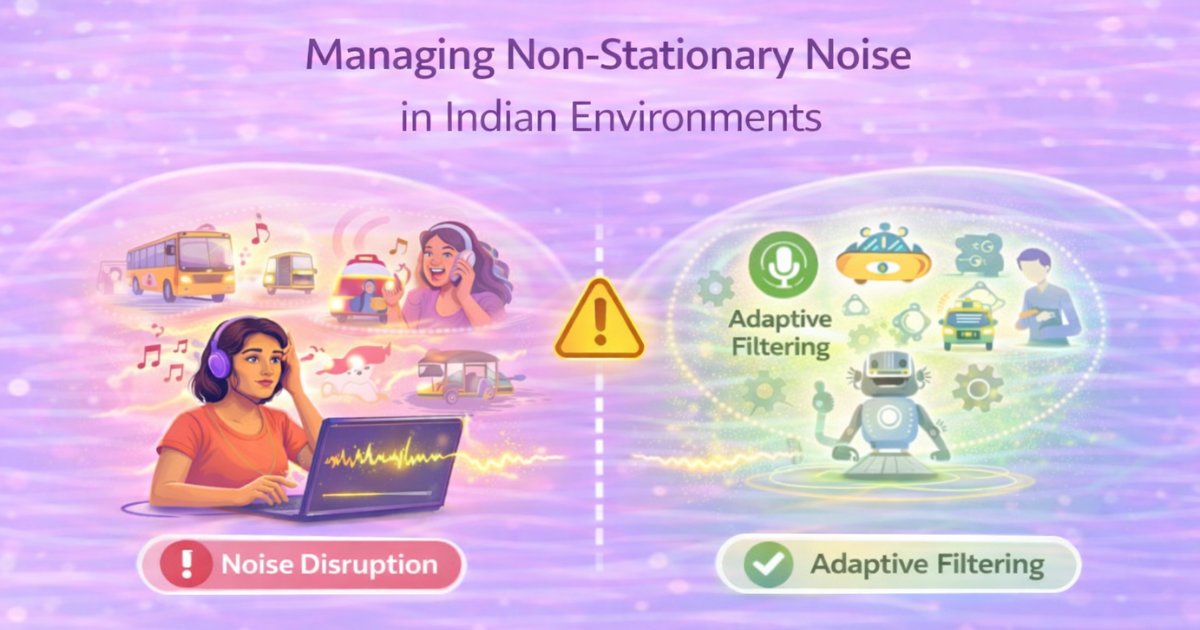
If you've ever attempted a business call from a Mumbai street, tried voice dictation in a Bangalore cafe, or joined a conference from home during Diwali, you understand the challenge. Indian acoustic environments aren't just noisy. They're spectacularly, uniquely unpredictable.
This isn't typical office background hum. This is layers of rapidly changing, overlapping sounds that challenge every assumption traditional noise cancellation algorithms make. Understanding how to handle non-stationary noise in these environments separates theoretical signal processing from production-ready systems.
What Makes Indian Environments Uniquely Challenging
The Non-Stationary Nature of Indian Soundscapes
Traditional noise cancellation was designed for stationary noise. The constant hum of air conditioning. The steady whoosh of airplane cabins. The predictable rumble of highway traffic. These sounds maintain stable spectral characteristics over extended periods.
Indian environments operate differently.
Street Markets and Urban Outdoor Spaces
A sudden vendor shout announcing fresh produce. The metallic clang of utensils at a roadside stall. Motorcycle horns layered with temple bells. Someone's phone blaring a Bollywood ringtone at maximum volume. Auto-rickshaw engines revving.
These sounds appear without warning, change intensity rapidly, overlap chaotically, and disappear just as suddenly. There's no stable noise floor to estimate or steady spectral signature to subtract.
Urban Residential Areas
The neighbor's pressure cooker whistle cuts through your video call. Construction drilling starts without notice. A religious procession with loudspeakers passes by. Children play cricket in the hallway. The chai wallah makes his distinctive call from the street.
Each sound has different spectral content, duration, and intensity. They don't follow patterns that stationary noise models expect.
Office and Coworking Environments
Overlapping conversations in multiple languages. Hindi, English, Tamil, Bengali, Marathi, often within the same conversation. Chai service with clinking cups and saucers. The inevitable chorus of people asking "Can you hear me?" on speakerphone calls.
None of these maintain steady characteristics. They emerge, evolve, and vanish continuously throughout the day.
The Multi-Lingual Acoustic Challenge
Standard noise cancellation systems face a problem they weren't designed to handle. What happens when background noise is speech in a different language than the target speaker?
An algorithm trained primarily on English might classify Hindi conversation in the background as noise and suppress it. But if the target speaker is also speaking Hindi, or code-switching between languages, the distinction becomes ambiguous.
The system needs to understand which speech is target and which is interference, regardless of language. This requires training on multilingual scenarios, not just noise versus speech classification.
Spectral Overlap with Cultural Sounds
Indian musical instruments and cultural sounds occupy frequency ranges that overlap directly with speech, creating particularly difficult separation problems.
Percussive Instruments
Tabla and dholak produce sharp transients in the 1 to 4 kHz range. This is exactly where consonants carry critical information for intelligibility. Simple spectral suppression in this range damages speech quality.
Religious and Cultural Sounds
Temple bells create harmonic structures that can confuse speech detection algorithms. The sustained tones contain fundamental frequencies and harmonics similar to vowel formants.
Azaan calls broadcast over loudspeakers contain speech-like spectral content at high volume. The algorithm must distinguish this from target speech without suppressing both.
Urban Transportation Noise
Vehicle horns don't produce simple tonal sounds. Auto-rickshaw horns, pressure horns, and standard car horns all occupy speech-critical frequencies with varying temporal patterns.
The distinctive auto-rickshaw engine sound creates rhythmic modulation that can interfere with pitch tracking in speech enhancement algorithms.
Celebration Sounds
Fireworks and firecrackers during festivals produce sudden, extremely loud transients. These can cause automatic gain control systems to misbehave, compressing target speech along with the explosion. Recovery from these events needs to happen quickly without audible artifacts.
Why Traditional Approaches Fail
Spectral Subtraction: Broken Assumptions
Classic spectral subtraction relies on estimating the noise spectrum during silent periods when only noise is present, then subtracting this estimate from noisy speech.
In Indian environments, truly silent periods rarely exist. Even brief quiet moments provide unreliable noise estimates. When a street vendor suddenly shouts or a motorcycle passes, the noise estimate becomes instantly outdated.
By the time you've adapted to current noise characteristics, they've already been replaced by something completely different. The fundamental assumption of stationarity breaks down.
Wiener Filtering: Chasing a Moving Target
Wiener filtering produces optimal noise reduction when noise characteristics remain relatively stable. It calculates time-varying gains based on estimated signal-to-noise ratios in each frequency band.
But when noise changes every few seconds, you're constantly adapting to conditions that no longer exist. The filter coefficients calculated for current noise become suboptimal immediately when new noise appears.
This constant adaptation creates audible artifacts as the filter hunts for optimal settings. Speech sounds modulated or garbled as gains fluctuate rapidly.
Energy-Based Voice Activity Detection
Simple VAD based on energy thresholds fails catastrophically in non-stationary environments. When background noise suddenly becomes louder than speech, the detector falsely identifies noise as speech and stops processing.
When loud transients appear (horn honks, door slams), the detector might miss actual speech immediately after because relative energy has changed dramatically.
Modern Deep Learning Solutions
Why Neural Networks Handle Non-Stationarity Better
Deep learning models don't make assumptions about noise stationarity. They learn patterns from diverse training data and develop internal representations that generalize to unseen noise types.
Temporal Context Modeling
Recurrent networks using LSTM or GRU architectures maintain state across time. They track how both speech and noise evolve through sequences.
When a horn suddenly honks, the model remembers what your voice sounded like moments before. This temporal memory helps separate transient noise from sustained speech, even when they overlap spectrally.
Learned Feature Representations
Instead of hand-crafted features like spectral subtraction or cepstral coefficients, neural networks learn optimal representations through training.
These learned features capture complex relationships between clean speech and various noise types. The network discovers which patterns indicate speech versus noise without explicit programming.
Multi-Condition Training
Models trained on diverse noise conditions (urban traffic, crowds, music, overlapping speakers) learn to handle variety.
Exposure to many noise types during training builds robustness. The network sees honking horns in some examples, construction drilling in others, crowd babble in others. It learns general principles of speech versus noise rather than specific noise signatures.
The Training Data Challenge
Most noise cancellation models are trained on Western acoustic environments. They've encountered aircraft cabin noise, office chatter, and city traffic. But they've never experienced:
The specific spectral signature of auto-rickshaw engines running on compressed natural gas. Pressure cooker whistles with their distinctive frequency sweep. Temple bells and azaan calls at high volume. The particular chaos of Indian traffic where dozens of horns overlap simultaneously. Street vendor calls in regional languages with characteristic intonation patterns. Festival sounds including Diwali crackers, Holi celebrations, and Ganesh Chaturthi processions.
Without training data representing these sounds, models struggle to handle them effectively in production. Building India-specific training datasets becomes essential.
This means recording thousands of hours of Indian acoustic environments paired with clean speech. Including regional variations because Mumbai traffic sounds different from Delhi traffic. Bangalore cafes have different acoustic signatures than Kolkata adda sessions. Regional accents and languages add another layer of complexity.
Adaptive Strategies for Dynamic Environments
Robust Voice Activity Detection
Accurate VAD becomes critical in non-stationary environments. The system must detect when target speech is present versus when background noise dominates, even when that background contains speech-like sounds.
Modern neural VAD models learn to distinguish target speech from background speech and non-stationary noise through pattern recognition, not just energy thresholds.
Models trained on multi-speaker scenarios handle the challenge of other people talking in the background. They learn to identify target speaker characteristics (direction if spatial information is available, vocal timbre, typical speech patterns) and classify other speakers as interference.
Continuous Noise Estimation
Instead of assuming noise remains stationary, modern systems continuously update noise estimates using multiple strategies.
Minimum Statistics Tracking
Track the minimum energy in each frequency band over a sliding window. This minimum value likely represents noise-only periods when target speech is absent in that band.
By continuously updating these minima and using the smallest values over recent history, the estimate tracks changing noise floors without requiring explicit silence detection.
Recursive Estimation with Adaptive Time Constants
Use exponential averaging with time constants that adapt to rate of change. When the noise floor changes dramatically (sudden honking, doors slamming), adapt quickly with short time constants. When relatively stable, average over longer periods to reduce estimation variance.
The challenge is detecting when to use fast versus slow adaptation without creating artifacts during speech.
Multi-Timescale Processing
Maintain both fast-adapting (100 to 200 milliseconds) and slow-adapting (1 to 2 seconds) noise estimates simultaneously.
Use the fast estimate for sudden transient noise like horn honks or door slams. Use the slow estimate for gradual changes in ambient noise level. Combine estimates based on detected conditions.
Dynamic Suppression Levels
SNR-Dependent Processing
When signal-to-noise ratio is high (clear speech above background), apply gentle processing to preserve naturalness. When SNR drops due to loud transient noise, temporarily increase suppression strength.
This adaptive approach prevents overprocessing artifacts during clean speech while still handling noise bursts effectively.
Confidence-Weighted Enhancement
Neural networks can output both a clean speech estimate and a confidence score indicating certainty in that estimate.
Apply stronger enhancement in regions where the model has high confidence it's detecting speech. Use gentler processing in low-confidence regions to avoid artifacts from uncertain decisions.
This graceful degradation prevents the harsh artifacts that occur when aggressive processing is applied incorrectly.
Practical Implementation Strategies
The Layered Processing Approach
Combine multiple techniques in sequence, each targeting specific noise characteristics:
Layer One: Transient Suppression
Detect and attenuate sudden loud events using onset detection and rapid gain reduction. Horn honks, pressure cooker whistles, door slams all create sharp energy increases that can be identified and suppressed quickly.
Use attack times of 5 to 10 milliseconds to catch transients fast, and release times of 50 to 100 milliseconds to avoid pumping artifacts.
Layer Two: Steady-State Noise Removal
Handle underlying continuous noise like traffic rumble, air conditioning, and machinery with either classical spectral subtraction or neural enhancement.
This layer assumes relatively stable characteristics over 1 to 2 second windows, which holds true for background noise even in dynamic environments.
Layer Three: Spatial Filtering
If multiple microphones are available, use beamforming to focus on the speaker's direction while rejecting sounds from other directions.
This proves particularly effective in conference scenarios or fixed installations where spatial assumptions hold.
Layer Four: Final AI Enhancement
Apply a deep learning model trained on Indian acoustic environments for final cleanup. This catches remaining noise that previous layers missed and polishes speech quality.
Training this final model on output from earlier processing layers (not clean speech with added noise) improves real-world performance.
Contextual Awareness Strategies
Location-Based Adaptation
Mobile devices know whether you're outdoors (street noise likely), in a vehicle (engine and road noise dominant), or indoors (different noise profile with potential reverberation).
Adapt processing strategy based on detected location. Outdoor processing prioritizes transient suppression. Vehicle processing expects steady engine noise. Indoor processing accounts for room acoustics and reverberation.
Temporal Pattern Learning
Mumbai streets sound different at 7 AM versus 7 PM. Morning has different traffic patterns than evening rush hour. Festival days create entirely different acoustic conditions than normal workdays.
Learning these patterns allows predictive adaptation. The system can prepare for expected noise types based on time and date.
User Behavior Adaptation
If users typically take calls from the same locations (home office, specific conference room, regular commute route), learn the acoustic signatures of those environments.
Build personalized noise profiles that optimize processing for frequently encountered conditions. This improves performance without requiring manual configuration.
Real-World Performance Expectations
Realistic Limitations
Even the best systems face fundamental limits in extreme conditions:
Extreme SNR Scenarios
When background noise exceeds speech by 20 dB or more (standing next to a loudspeaker during a procession, next to construction equipment), no algorithm can reliably recover intelligible speech.
The information simply isn't present in the signal. Physics imposes hard limits that software can't overcome.
Overlapping Speech
When someone nearby speaks at similar volume to the target speaker, single-channel separation becomes fundamentally difficult.
Without spatial information to distinguish speakers by direction, the algorithm must rely on speaker characteristics (pitch, timbre, speaking style). This works imperfectly and creates artifacts.
Artifacts Versus Noise Tradeoff
Aggressive suppression of highly non-stationary noise introduces processing artifacts. Speech can sound metallic, reverberant, or phasey.
Sometimes preserving modest background noise sounds more natural than aggressively removing it at the cost of speech quality. Finding this balance requires careful tuning.
Implementation Recommendations by Use Case
Real-Time Communication Applications
Latency Requirements
Target under 30 milliseconds algorithmic latency for voice and video calls. Indian users experience network delays inherent to mobile infrastructure. Adding significant algorithmic latency creates noticeable lag that disrupts natural conversation.
Use streaming architectures that process small frame sizes (10 to 20 milliseconds) with minimal look-ahead. Low-latency pipeline design becomes critical.
Progressive Enhancement
Start with lightweight processing for minimal latency. As audio buffers fill, apply deeper processing that uses more context.
This ensures immediate response while still achieving high quality once sufficient context accumulates.
Thermal Throttling Considerations
Mobile processors thermal throttle in Indian heat, especially during extended video calls. Design graceful degradation that switches to simpler algorithms when computational headroom decreases.
Monitor CPU temperature and processing load. When approaching thermal limits, reduce model complexity rather than dropping frames or introducing glitches.
Recorded Content Processing
Leveraging Offline Processing
Podcasts, videos, and voice notes have no real-time constraints. Use larger temporal context windows (500 milliseconds to 1 second). Deploy deeper networks with more parameters. Perform multiple processing passes.
This produces maximum quality by using all available information and computational resources.
Preserving Acoustic Authenticity
For content creation, complete silence sounds unnatural and disconnected from reality. Subtle environmental ambience grounds audio in real spaces.
Leave gentle background cues that indicate the recording environment without distracting from speech. Complete sterile silence often sounds worse than modest controlled background.
ASR and Transcription Systems
Conservative Processing Philosophy
Over-aggressive denoising damages ASR accuracy. Spectral artifacts confuse acoustic models. Removed speech harmonics reduce recognition confidence.
Preserve speech characteristics even if modest noise remains. Modern ASR systems trained on noisy data handle background noise better than they handle processing artifacts.
Language-Specific Optimization
ASR models trained on Indian languages benefit from different noise reduction profiles than English-only systems. Indian language ASR expects certain phonetic characteristics and prosodic patterns.
Tune noise suppression to preserve language-specific features critical for accurate recognition. Hindi retroflexes, Tamil gemination, and other distinctive phonemes need careful handling.
Measurement and Evaluation
Beyond Standard Metrics
Signal-to-noise ratio improvement and spectral distortion metrics developed for stationary noise don't capture performance in non-stationary conditions.
Transient Suppression Rate
Measure how effectively the system detects and suppresses sudden loud events. What percentage of horn honks get attenuated? How quickly does the system recover?
Speech Preservation During Transients
During noise bursts, does speech remain intelligible? Or does aggressive suppression also damage speech?
Adaptation Speed
How quickly does the system adapt when noise characteristics change? Measure performance in the seconds following major acoustic changes.
Subjective Naturalness
Objective metrics miss processing artifacts that humans find objectionable. Regular listening tests with diverse noise conditions provide critical feedback.
Include both clean speech quality ratings and intelligibility testing in realistic noisy scenarios.
Conclusion: Building Robust Systems for Complex Environments
Indian acoustic environments represent an ultimate stress test for noise cancellation technology. The variety, unpredictability, and spectral complexity of sounds challenge every assumption traditional algorithms make.
But systems that handle Indian conditions can handle virtually anything. Build robust noise cancellation for Mumbai traffic, and New York traffic becomes straightforward. Make it work for Delhi markets, and Tokyo subways pose little challenge.
The key is abandoning assumptions about noise stationarity. Embrace deep learning approaches that generalize across diverse conditions. Build training datasets reflecting real acoustic diversity. Design adaptive systems that gracefully handle the unexpected rather than seeking perfect algorithms for idealized conditions.
Success requires combining classical signal processing with modern machine learning. Layer multiple techniques that each address specific challenges. Adapt processing based on context and conditions. Test extensively in real environments, not just laboratory conditions.
At Fonadalabs, our models are trained on diverse acoustic conditions including the complex soundscapes typical of urban Indian environments. We handle everything from traffic noise to multilingual backgrounds, delivering clean speech optimized for downstream applications while preserving naturalness. Whether processing telephony audio or handling call center recordings, our systems adapt to real-world acoustic complexity.
The acoustic chaos of Indian environments isn't a problem to be solved completely. It's a reality to be handled gracefully through intelligent, adaptive processing that respects both the physics of sound and the practical constraints of production systems.