
Trade-offs Between Neural Vocoders for Production TTS Systems
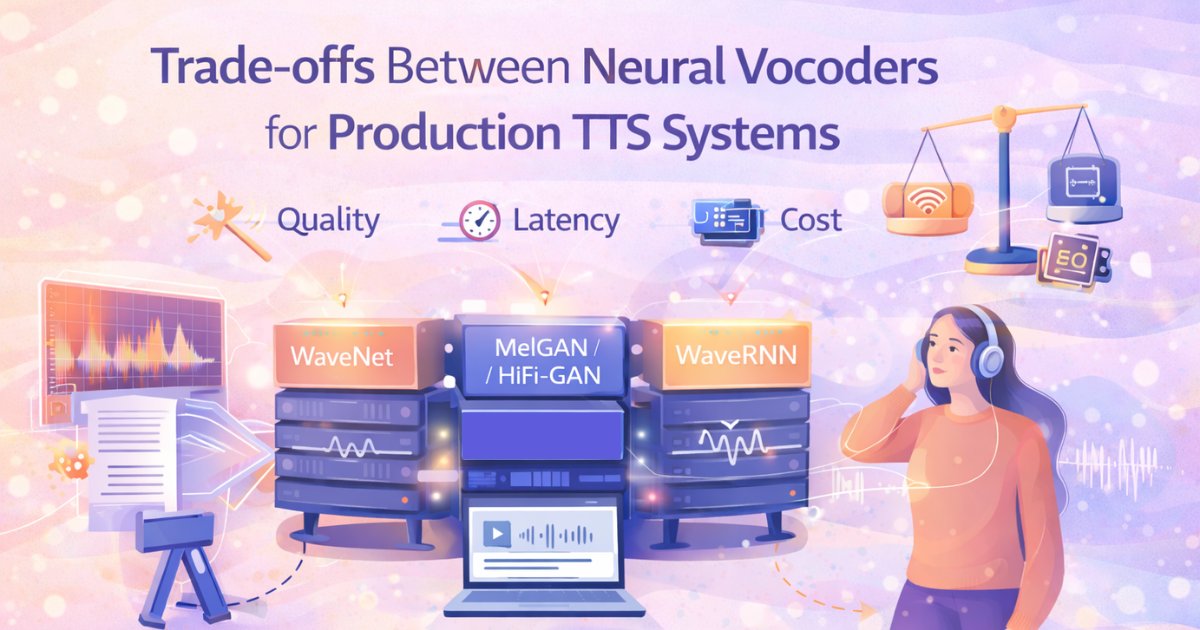
The magic behind natural-sounding text-to-speech lies in neural vocoders, the algorithms that transform acoustic features into actual audio waveforms. But choosing the right vocoder for production isn't just about quality; it's a delicate balance of performance, latency, and computational cost.
The Vocoder Landscape
Think of vocoders as the final translator in your TTS pipeline. Your model generates mel-spectrograms (visual representations of sound), and the vocoder converts these into audio waves you can actually hear. The question is: which translator do you hire?
WaveNet was the pioneer that changed everything. Using dilated convolutions, it generates audio sample by sample with incredible quality. The catch? It's painfully slow, taking seconds to generate one second of audio. Great for demos, impractical for production at scale.
WaveGlow and WaveRNN offered middle-ground solutions. WaveGlow uses normalizing flows for parallel generation, dramatically speeding up synthesis. WaveRNN employs recurrent networks with clever optimizations. Both deliver solid quality with reasonable speed, but still demand significant GPU resources.
The Modern Contenders
MelGAN and HiFi-GAN represent the current sweet spot for production systems. These generative adversarial networks achieve near-WaveNet quality at 100x faster speeds. HiFi-GAN, in particular, has become the industry darling, it generates high-fidelity audio in real-time on modest hardware.
The architecture is clever: multi-scale discriminators evaluate audio at different resolutions, ensuring quality across frequency ranges. Multi-receptive field fusion modules capture both fine-grained and broad audio patterns. Result? Natural prosody, minimal artifacts, and production-ready speed.
Parallel WaveGAN strikes a different balance – simpler architecture, faster training, slightly lower quality. Perfect when you need "good enough" speech at minimal computational cost.
Production Trade-offs That Matter
Latency vs Quality: WaveNet sounds perfect but is too slow. MelGAN is fast but can introduce metallic artifacts. HiFi-GAN hits the sweet spot for most applications – high quality with ~10ms generation time per second of audio.
Memory Footprint: Smaller models like Parallel WaveGAN (under 10MB) fit easily on edge devices. HiFi-GAN models range from 15-50MB depending on configuration. WaveNet can exceed 100MB. For mobile or IoT deployment, size matters.
Computational Cost: This directly impacts your infrastructure bills. A HiFi-GAN model might handle 100 concurrent streams on a single GPU. WaveNet? Maybe 5. At scale, this difference translates to tens of thousands in monthly costs.
Audio Quality Metrics: MOS (Mean Opinion Score) tells only part of the story. Consider speaker similarity, prosody naturalness, and handling of edge cases like numbers, acronyms, and code-mixing.
Making Your Choice
For production systems, start with HiFi-GAN or its variants. The quality-speed-cost triangle is well-balanced. Need absolute best quality for premium applications? Consider WaveNet with aggressive caching. Building for edge devices? Parallel WaveGAN might be your friend.
The future points toward even more efficient architectures, diffusion-based vocoders and neural codec models promise WaveNet quality at MelGAN speeds. But for today's production needs, the HiFi-GAN family remains the pragmatic choice.
Fonada Labs has done the heavy lifting, optimizing vocoders so you don't have to. Natural-sounding voices across four languages, real-time streaming, and production-grade reliability are just a few API calls away.
Because great voice experiences shouldn't require a PhD in neural architectures, they should just work.