
Building Real-Time Audio APIs Using WebSockets at Scale: Engineering Production-Grade Voice Infrastructure
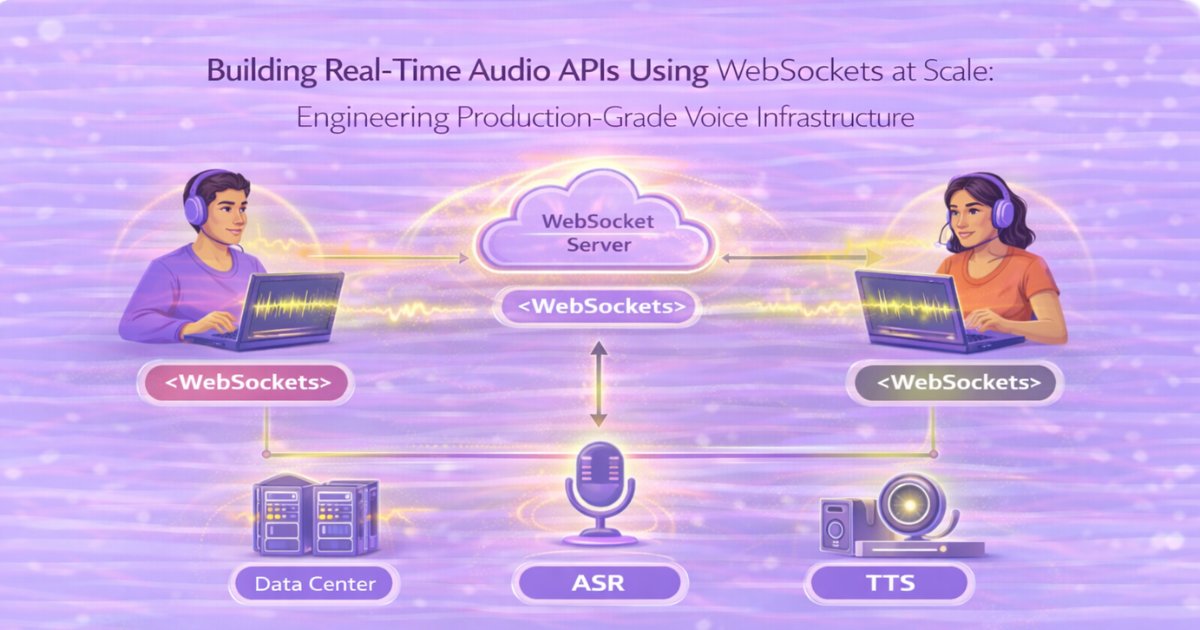
Picture thousands of simultaneous voice calls, each streaming audio in real-time, expecting processing in milliseconds, demanding near-zero packet loss. This is the reality of building production-grade real-time audio APIs.
HTTP REST APIs work well for many applications, but real-time audio isn't one of them. The request-response model creates unacceptable latency for conversational applications. You need bidirectional streaming, minimal overhead, and persistent connections. You need WebSockets.
Understanding how to architect WebSocket-based audio systems separates toy demos from scalable production infrastructure.
Why WebSockets for Audio Processing
The HTTP Limitation Problem
Traditional REST APIs follow a simple pattern. Client sends request. Server processes. Server sends response. Connection closes. This creates fundamental problems for audio streaming:
Latency Overhead
Every audio chunk requires a new HTTP connection, adding 50 to 200 milliseconds of latency per request. For real-time audio at 20 millisecond frame rates, this overhead exceeds the actual audio duration. You'd spend more time establishing connections than transmitting data.
Connection Overhead
HTTP headers add 500 to 800 bytes per request. For a 10 millisecond audio chunk (320 bytes at 16 kHz mono), headers become larger than the payload itself. This creates massive bandwidth waste and processing overhead.
Polling Inefficiency
Without persistent connections, clients must poll for responses. This introduces either additional latency (if polling interval is too long) or excessive traffic (if polling too frequently). Neither option works for real-time requirements.
The WebSocket Advantage
WebSockets provide persistent, full-duplex communication channels that solve these problems:
Single Connection
Establish connection once, then stream indefinitely. Connection overhead gets amortized across the entire session instead of recurring for every chunk.
Minimal Framing
WebSocket frames add only 2 to 14 bytes of overhead per message. For small audio chunks, this represents less than 5% overhead compared to HTTP's often 200% overhead.
Bidirectional Streaming
Clients send audio chunks while simultaneously receiving processed chunks back. No polling. No waiting. No request-response coordination overhead.
Server Push Capability
Servers can send data to clients without explicit requests. This enables immediate delivery of processed audio as soon as it's ready, minimizing end-to-end latency.
Architecture: The Production System Design
A production-ready architecture for real-time audio processing at scale requires several specialized layers, each solving specific problems.
System Component Overview
Gateway Servers
Handle WebSocket connections but don't process audio themselves. One gateway server can manage 5,000 to 10,000 concurrent WebSocket connections using lightweight async frameworks.
These servers focus purely on connection management, message routing, and protocol handling. They remain stateless regarding audio processing, making them easy to scale horizontally.
Message Queues
Decouple gateway servers from processing workers, allowing independent scaling. Redis Streams hits the sweet spot for real-time audio with sub-millisecond latency and millions of messages per second throughput.
Queues provide buffering during traffic spikes and enable graceful degradation when processing capacity is temporarily exceeded.
Processing Workers
Run actual audio processing like noise cancellation, ASR, or enhancement. These are CPU or GPU intensive, so they scale independently from gateway servers.
Workers can be heterogeneous, with different types optimized for different workloads. GPU workers for neural network inference. CPU workers for classical signal processing.
The WebSocket Gateway Layer
Connection Management Implementation
Use async frameworks that handle thousands of concurrent connections efficiently without thread-per-connection overhead:
Framework Options
Python's asyncio with websockets library provides excellent developer experience and handles 5,000+ connections per instance. Node.js with native event loop leverages JavaScript's async nature for efficient connection management. Go with goroutines enables lightweight concurrency with minimal memory overhead. Rust with tokio delivers maximum performance for latency-critical applications.
Choose based on team expertise and specific requirements. All can handle production scale with proper optimization.
Protocol Design Principles
Keep protocol simple and efficient. Complexity increases debugging difficulty and introduces failure modes.
Frame Type Usage
Use binary frames for audio data to minimize overhead. No base64 encoding. No JSON wrapping. Pure audio bytes.
Use text frames for control messages. JSON provides human-readable debugging and flexible schema evolution. The slight overhead doesn't matter for infrequent control messages.
Connection Lifecycle
Connection starts with HTTP upgrade to WebSocket. Client sends authentication message containing API key and configuration parameters (sample rate, channels, processing options).
During streaming, clients send binary audio chunks, typically 320 bytes for 10 milliseconds at 16 kHz mono. Servers immediately send back binary processed chunks without waiting for subsequent requests.
Heartbeat messages every 30 to 60 seconds detect dead connections. Either side can send ping frames requiring pong responses within timeout windows.
Authentication and Security
Token-Based Authentication
Clients send API keys in the initial WebSocket message, not in the URL. URLs get logged by proxies, load balancers, and web servers. Credentials in URLs create security risks.
Generate short-lived session tokens upon authentication. Use these tokens for message signing or encryption to prevent replay attacks.
Rate Limiting
Track message rate per connection. Limit audio chunk frequency to prevent abuse. Typical limits allow 100 to 120 chunks per second (slightly above real-time for buffering) with burst allowance for temporary spikes.
Implement connection rate limiting per API key. Prevent single user from opening thousands of connections and exhausting resources.
Encrypted Connections
Always use encrypted WebSocket connections (wss://) not unencrypted (ws://). Audio data is sensitive. Unencrypted transmission exposes user conversations to network eavesdropping.
Use TLS 1.3 for improved performance and security. Disable older protocols like TLS 1.0 and 1.1.
The Message Queue Layer
Why Queues Matter
Gateway servers and processing workers need independent scaling. Queues decouple them, allowing you to scale gateways based on connection count and workers based on processing load.
Without queues, gateways must directly invoke processing, creating tight coupling. Worker failures impact gateways. Gateway scaling requires worker scaling even when processing capacity is sufficient.
Message Flow Architecture
Publishing Flow
Gateway receives audio chunk from WebSocket. Constructs message containing session ID, chunk sequence number, audio data, and timestamp. Publishes to Redis stream associated with session.
Include timestamps to measure queuing delays. Track sequence numbers to detect lost messages.
Consumption Flow
Processing worker consumes from Redis using consumer groups. Processes audio chunk. Publishes result back to Redis stream for outbound messages. Gateway consumes results and forwards to appropriate WebSocket connection.
Per-Session Streams
Each WebSocket session gets its own Redis stream. This provides isolation between sessions and enables independent stream management. One slow session doesn't block others.
Stream names include session IDs. Automatic cleanup removes streams when sessions end. Prevents memory leaks from abandoned sessions.
Queue Management
Depth Monitoring
Track queue depth per stream. Alert when depth exceeds thresholds indicating processing can't keep up with incoming rate.
For real-time audio, queue depth should remain near zero under normal conditions. Growing queues indicate bottlenecks requiring immediate attention.
Message Expiration
Set TTLs on messages. Audio chunks older than a few seconds are useless for real-time applications. Discard them rather than processing stale data.
This prevents processing backlogs during recovery from outages. Skip to current audio rather than catching up on old chunks.
The Processing Worker Layer
Worker Architecture Principles
Stateless Processing
Workers process one chunk at a time without maintaining session state. All context needed for processing arrives with the message.
Stateless workers simplify scaling and failure recovery. Any worker can process any message. No state migration when workers fail.
Specialized Worker Types
Separate GPU workers from CPU workers for optimal resource utilization. GPU workers run neural network-based noise reduction. CPU workers handle classical signal processing like filtering and resampling.
This specialization allows precise resource allocation. Expensive GPU instances only for workloads requiring them.
Batching for Efficiency
Neural network inference is dramatically more efficient on batches than single samples. A single GPU worker can process 50 to 100 audio streams simultaneously with proper batching, versus 5 to 10 without batching.
Dynamic Batching Implementation
Workers collect chunks from multiple sessions over short time windows (5 to 20 milliseconds). Batch them together into single tensor. Run inference once. Route results back to correct sessions based on batch indices.
This requires careful timeout management. Don't wait too long building batches or you add latency. Don't batch too aggressively or throughput suffers during low traffic.
Batch Size Optimization
Measure GPU utilization at different batch sizes. Find the sweet spot where GPU stays fully utilized without excessive memory consumption.
Typical batch sizes range from 32 to 128 depending on model architecture and GPU memory. Monitor inference time versus batch size to find optimal operating point.
Model Optimization for Production
Quantization
Convert models from FP32 to INT8 or INT4 through quantization. Achieve 4x smaller models and 2x to 4x faster inference with minimal accuracy loss.
Post-training quantization works well for most models. Quantization-aware training provides better accuracy if post-training quantization degrades quality too much.
Model Export and Runtime
Export models to ONNX format for optimized cross-platform inference. ONNX Runtime provides efficient execution on CPUs and GPUs with extensive hardware-specific optimizations.
TensorRT for NVIDIA GPUs delivers maximum performance through graph optimization and kernel fusion. Build low-latency pipelines by combining efficient models with optimized runtimes.
Graph Optimization
Fuse consecutive operations to reduce memory bandwidth. Eliminate unnecessary nodes. Constant fold where possible. These optimizations happen automatically with ONNX Runtime or TensorRT but verify they're actually applied.
Load Balancing Strategies
Gateway Load Balancing
Layer 4 Load Balancing
Use Layer 4 load balancers like AWS Network Load Balancer or HAProxy for WebSocket gateways. These operate at TCP level without inspecting HTTP content.
Implement IP hash or connection-based routing to stick each client to one gateway server for the session duration. WebSocket connections are stateful, so requests from same client must reach same gateway instance.
Health Checks
Configure health checks that verify WebSocket upgrade capability, not just TCP connectivity. Some health check failures indicate gateway problems. Others indicate backend issues.
Implement graceful shutdown where gateways stop accepting new connections but allow existing sessions to complete before terminating.
Worker Load Balancing
Workers pull from message queues, creating self-balancing behavior. Consumer groups in Redis ensure each message goes to exactly one worker.
Fast workers process more messages. Slow workers process fewer. No explicit load balancing logic required.
Queue Sharding
Shard queues by session characteristics. Route CPU-intensive classical processing to CPU worker pools. Route neural enhancement to GPU worker pools.
This specialization improves resource utilization and simplifies capacity planning.
Monitoring and Observability
Critical Metrics
Gateway Metrics
Active WebSocket connections per server. Track current count, maximum capacity, and utilization percentage.
Messages received and sent per second. Measure both rates and bytes transferred.
Connection establishment rate. Spikes indicate potential attacks or legitimate traffic surges requiring scaling.
Connection duration distribution. Understand typical session lengths for capacity planning.
Worker Metrics
Queue depth across all streams. Growing queues indicate insufficient processing capacity.
Processing latency per chunk. Measure time from message consumption to result publication.
GPU and CPU utilization. Ensure resources are fully utilized but not overloaded.
Inference time per model. Track neural network execution time separately from total processing time.
End-to-End Metrics
Round-trip latency from client sending audio to receiving processed audio back. This matters most for user experience.
Packet loss rate. Count chunks that don't receive responses within timeout windows.
Session duration and completion rate. Understand how many sessions complete successfully versus disconnecting prematurely.
Alerting Strategy
Critical Alerts
Queue depth exceeding 1,000 messages indicates severe processing bottleneck. Scale workers immediately.
Gateway connection rate exceeding 80% capacity requires adding gateway instances before connections get rejected.
Worker error rate above 5% suggests processing bugs or infrastructure issues.
Average latency above 100 milliseconds creates poor user experience requiring investigation.
Warning Alerts
Queue depth exceeding 500 messages provides early warning before critical threshold.
Gateway utilization above 60% suggests planning scaling to handle additional growth.
Worker utilization consistently below 20% indicates overprovisioning and cost optimization opportunities.
Scaling Strategies
Horizontal Scaling Rules
Gateway Scaling
Scale up when active connections exceed 7,000 per server to maintain headroom for spikes.
Scale down when connections fall below 3,000 per server to optimize costs.
Maintain minimum 2 gateway servers for redundancy even during low traffic.
Worker Scaling
Scale up when queue depth exceeds 500 messages indicating processing can't keep pace.
Scale down when queue depth remains below 50 messages and CPU or GPU utilization drops below 30%.
Use gradual scaling. Add or remove workers slowly to avoid oscillation.
Geographic Distribution
For global users, deploy regionally. Gateway servers in each major region provide low-latency connections to nearby users.
Load balancers route clients to nearest region based on geographic IP routing or latency measurements.
Workers can be centralized or distributed. Centralized provides better resource utilization. Distributed reduces data transfer costs and latency.
Failure Handling and Resilience
Connection Failure Management
Client Reconnection Logic
Provide client SDKs with automatic reconnection using exponential backoff. Start with 1 second delay, double after each failed attempt, cap at 60 seconds.
Add jitter to prevent thundering herd when multiple clients reconnect simultaneously after regional outage.
Session Resumption
Allow session resumption where clients can resume with same session ID if disconnected briefly. Server maintains session state for 30 to 60 seconds after disconnection.
This prevents loss of conversation context during momentary network hiccups.
Worker Failure Handling
Graceful Shutdown
Workers finish current batch before shutting down. Acknowledge message consumption only after successfully publishing results.
New messages get routed to other workers automatically through consumer group rebalancing.
Processing Error Recovery
Catch exceptions during audio processing. Return error messages to clients explaining the failure. Continue session rather than terminating it.
Log errors with full context for debugging. Include session ID, chunk sequence number, and error details.
Implement retry logic for transient failures. Network errors, temporary resource exhaustion, or timeout errors might succeed on retry.
Cost Optimization Strategies
Computational Cost Reduction
Spot Instances
Use spot instances for processing workers providing 60% to 70% cost savings versus on-demand pricing.
Implement graceful handling of spot instance termination. When termination notice arrives, stop accepting new messages and drain current queue before shutdown.
Aggressive Batching
Maximize GPU utilization through larger batch sizes. GPUs are expensive. Running them at 50% utilization wastes money.
Monitor GPU memory usage. Increase batch size until memory becomes constraining factor.
Network Cost Optimization
Regional Processing
Process audio in the same region where it arrives. Cross-region data transfer costs add up quickly with high-volume audio streaming.
Route sessions to processing workers in same region as gateway that accepted connection.
Compression for Non-Real-Time
For use cases tolerating additional latency, compress audio before transmission. Opus codec at 32 kbps provides excellent speech quality with 10x size reduction versus uncompressed PCM.
Real-time applications can't afford compression latency. Non-real-time applications (transcription, post-processing) benefit significantly.
Client SDK Best Practices
Hiding Complexity
Provide official SDKs in common languages to hide WebSocket complexity from developers.
Handle connection management, reconnection, heartbeat, and timeout automatically within SDK. Developers shouldn't need to understand WebSocket protocol details.
Simple API Surface
The API should be simple. Create client with API key. Specify callback for processed audio. Start streaming.
Example pseudo-code:
client = AudioAPI(api_key)
client.on_processed_audio(callback_function)
client.start_stream(audio_source)
Everything else happens automatically. Connection establishment, authentication, chunk transmission, result reception.
Error Handling
Emit clear error events for different failure modes. Network errors. Authentication failures. Processing errors. Rate limit exceeded.
Provide error codes and human-readable messages enabling developers to handle failures appropriately.
Performance Benchmarking
Latency Measurement
Measure latency at each pipeline stage. Gateway to queue. Queue to worker. Worker processing time. Worker to queue. Queue to gateway. Gateway to client.
Identify bottlenecks through per-stage measurement. Optimize the slowest components first.
Load Testing
Simulate thousands of concurrent connections using load testing tools. Measure system behavior under increasing load.
Find breaking points. At what connection count do gateways become unstable? What queue depth causes workers to fall behind?
Test failure scenarios. Kill workers during load tests. Disconnect gateways. Verify graceful degradation.
Conclusion: Engineering for Scale and Reliability
Building real-time audio APIs with WebSockets differs fundamentally from traditional REST APIs. Success requires embracing several key principles:
Separate connection handling from processing. Gateways and workers scale independently based on different constraints.
Use queues for decoupling and back-pressure management. Queues absorb traffic spikes and enable graceful degradation.
Batch aggressively for GPU efficiency. Single-sample processing wastes expensive compute resources.
Monitor everything. Observability enables rapid problem detection and resolution.
Plan for failures. Implement graceful degradation rather than catastrophic failure.
The architecture described here handles production scale reliably. Gateway layers managing tens of thousands of connections. Worker layers processing hundreds of simultaneous audio streams. Queue layers providing buffering and routing.
At Fonadalabs, we've built our noise cancellation API with these principles in mind, offering WebSocket streaming that handles real-time audio processing at scale. Our architecture supports low-latency voice applications while maintaining high throughput and reliability. Whether handling telephony audio or streaming ASR workloads, our infrastructure scales elastically to meet demand.
Real-time audio processing at scale requires careful engineering. But with proper architecture, it's entirely achievable. The key is understanding the unique requirements of audio streaming and building systems specifically optimized for those requirements rather than adapting general-purpose REST patterns.