
How Speech to Text Works: Understanding Accuracy and Challenges
Anyone who has used voice commands on their phone knows the frustration. You speak clearly, enunciate carefully, and yet your device transcribes "I need to buy eggs" as "I knead two bye legs." While amusing, these failures highlight a fundamental challenge in speech recognition: the gap between how we think we speak and how we actually speak.
Speech to text technology has come remarkably far in recent years, but building systems that can handle the messy reality of human communication remains one of the most complex problems in artificial intelligence. The challenge isn't just about recognizing words. It's about surviving the beautiful chaos of how humans actually talk.
The Messy Reality of Human Speech
Laboratory speech is pristine. People speak clearly, pause between sentences, and articulate every syllable. Real-world speech is an entirely different beast. We mumble, we slur words together, we start sentences and abandon them halfway through. We say "um" and "uh" constantly. We talk with food in our mouths, over background music, while walking down noisy streets, and sometimes all three simultaneously.
Consider a simple phrase like "going to." In casual speech, this becomes "gonna." The phrase "want to" transforms into "wanna." "Did you eat yet?" compresses into something resembling "jeet yet?" These aren't mistakes or lazy speech. This is how language actually works in practice. Any speech recognition system that expects textbook pronunciation will fail immediately in the real world.
The acoustic variability is staggering. The same word spoken by different people can have wildly different acoustic signatures depending on their accent, speaking rate, emotional state, and whether they've had their morning coffee yet. A word spoken by a teenager sounds different from the same word spoken by their grandfather. Regional accents add another layer of complexity. The word "water" has dozens of distinct pronunciations across English-speaking regions alone.
Then there's the environment. Speech recognition systems need to work in quiet offices, crowded restaurants, moving cars, and windy outdoor spaces. They need to filter out background conversations, handle phone line compression, and deal with the acoustic properties of different rooms. A system trained exclusively on clean audio recordings will collapse when confronted with real-world acoustic conditions.
How Modern Systems Actually Work
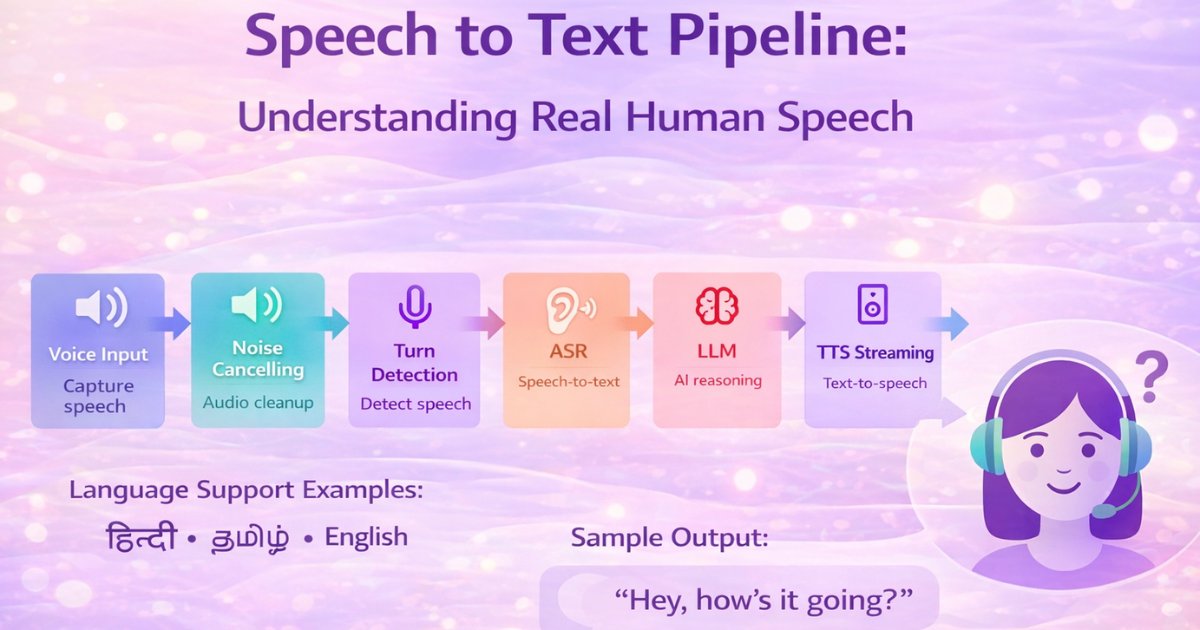
Modern speech to text systems are built on deep learning architectures that process audio through multiple stages. The journey from sound waves to text involves several distinct steps, each solving a different piece of the puzzle.
First, the audio signal gets preprocessed and converted into a representation the neural network can understand. Raw audio waveforms contain too much information and not enough structure. Instead, systems typically convert audio into spectrograms, which show how the frequency content of sound changes over time. These spectrograms capture the essential acoustic features while discarding irrelevant details.
The acoustic model takes these spectrograms and produces a sequence of probability distributions over phonemes or characters. This model has learned the relationship between acoustic patterns and linguistic units by training on thousands of hours of labeled speech data. Modern acoustic models use architectures like transformers or recurrent neural networks that can capture long-range dependencies in the audio signal.
But producing a sequence of probable phonemes isn't enough. Speech recognition systems need to convert these phoneme sequences into actual words, and this is where language models enter the picture. Language models provide crucial context about which word sequences are probable in the target language. They help the system choose "recognize speech" over "wreck a nice beach," even though these phrases sound nearly identical.
The decoding step combines information from both the acoustic and language models to produce the final transcription. This is a search problem, finding the most likely word sequence given both the acoustic evidence and the linguistic constraints. Efficient search algorithms make this computationally tractable even though the space of possible transcriptions is enormous.
The Data Challenge
Building robust speech recognition systems requires massive amounts of training data, and not just any data. The data needs to reflect the actual diversity of human speech. This means recordings from speakers of different ages, genders, accents, and speaking styles. It means audio captured in different acoustic environments with various types of background noise.
Collecting this data is expensive and time-consuming. Someone needs to record the speech, and someone needs to transcribe it accurately. For many languages and dialects, such datasets simply don't exist at the scale needed for modern deep learning approaches. This creates a disparity where speech recognition works well for standard American English but struggles with Scottish English, African American Vernacular English, or non-native speakers with strong accents.
The data also needs to represent how people actually talk, not how they think they talk. This means including disfluencies, false starts, incomplete sentences, and all the other messy features of spontaneous speech. Training exclusively on read speech from audiobooks produces systems that fail on conversational speech where people think out loud and change direction mid-sentence.
Handling rare words and proper names presents another challenge. A system might never have encountered the name "Chukwuemeka" or the technical term "phenylthiocarbamide" during training. Without having heard these words before, the system must somehow produce reasonable transcriptions based on context and linguistic patterns.
Accents and the Fairness Problem
Speech recognition systems don't work equally well for everyone, and this isn't just an inconvenience. It's a fairness issue with real consequences. Studies have consistently shown that commercial speech recognition systems have significantly higher error rates for speakers with non-native accents or regional dialects that differ from the training data distribution.
When a voice assistant consistently misunderstands someone because of their accent, it's not just frustrating. It can prevent them from accessing services, using technology effectively, or participating fully in increasingly voice-enabled interfaces. If your accent means the speech recognition system in your car navigation works poorly, you're at a genuine disadvantage.
The problem stems from the training data. Most large speech datasets are dominated by speakers of standardized dialects, often younger, educated speakers from specific geographic regions. Systems trained on this data learn to recognize that particular way of speaking very well, but struggle with the enormous phonetic variability found in global English or other languages.
Solving this requires intentionally diversifying training data and evaluating system performance across different demographic groups. It means collecting data from speakers with different accents and ensuring the system works acceptably for all of them, not just optimizing for average performance. Some researchers are exploring techniques for accent adaptation that can tune models to individual speakers or accent groups.
Dealing with Ambiguity
Human speech is fundamentally ambiguous. The same acoustic signal can correspond to different word sequences, and context determines which interpretation makes sense. "I scream" and "ice cream" are acoustically nearly identical. So are "four candles" and "fork handles," a distinction that requires understanding what items someone might reasonably request at a hardware store.
Context operates at multiple levels. At the acoustic level, surrounding sounds influence how we perceive individual phonemes. At the linguistic level, preceding words constrain what words are likely to follow. At the semantic level, understanding the topic of conversation helps disambiguate words. "Patients" and "patience" sound identical, but medical transcription systems can use context to choose correctly.
Modern systems handle ambiguity by maintaining multiple hypotheses throughout the recognition process and using increasingly rich context to prune unlikely interpretations. Attention mechanisms in neural networks allow models to focus on relevant context when making decisions about ambiguous sounds. Large language models have dramatically improved the ability to use semantic context for disambiguation.
However, some ambiguities can't be resolved without information beyond the audio signal itself. When someone says "there," "their," or "they're" in isolation, even humans can't determine which spelling is intended. Speech recognition systems face the same limitation.
The Future of Robustness
Recent advances suggest several promising directions for making speech recognition more robust. Self-supervised learning techniques can leverage vast amounts of unlabeled audio data, learning rich acoustic representations without requiring expensive transcriptions. Models like Wav2Vec 2.0 have shown that pretraining on unlabeled audio dramatically reduces the amount of labeled data needed to achieve good performance.
End-to-end models that directly map audio to text without intermediate phoneme representations are becoming more practical. These models can potentially learn more flexible mappings that handle pronunciation variability better than traditional pipeline approaches. However, they require even larger amounts of training data and can be harder to debug when they fail.
Multimodal approaches that combine audio with other information sources show promise. Visual information from lip movements can help disambiguate speech in noisy environments. Text context from previous utterances helps maintain conversational coherence. Knowledge about the user's location, time of day, and current activity can provide useful priors for what they might be talking about.
Adaptation techniques are improving, allowing systems to tune themselves to individual speakers, specific acoustic environments, or particular domains. Some systems can now adapt in real-time, learning from their mistakes and improving as they interact with a user.
Conclusion
Teaching machines to understand human speech means confronting the reality that human communication is fundamentally messy, variable, and context-dependent. The gap between laboratory conditions and real-world usage is vast. Building robust speech recognition systems requires massive diverse datasets, sophisticated models that can handle variability, and careful attention to ensuring the technology works fairly across different speakers and contexts.
We've made remarkable progress. Modern speech recognition systems can transcribe conversational speech with impressive accuracy in many scenarios. But significant challenges remain, particularly around accent robustness, handling disfluent speech, and working in challenging acoustic environments. The goal isn't perfect transcription under ideal conditions. The goal is reliable performance with real humans speaking naturally in the messy, noisy, diverse ways that humans actually communicate.