
Real-time vs Batch Speech Recognition: Difference, Architecture, and Common Issues
You'd think transcribing speech is transcribing speech, right? Record audio, send it to an ASR system, get text back. Simple.
Except it's not.
The difference between real-time and batch ASR isn't just about speed. It's about fundamentally different architectures, trade-offs, and the creative ways each one can fail. Understanding these differences matters because choosing the wrong approach doesn't just slow things down, it breaks the entire experience.
The Core Difference: Waiting vs Flowing
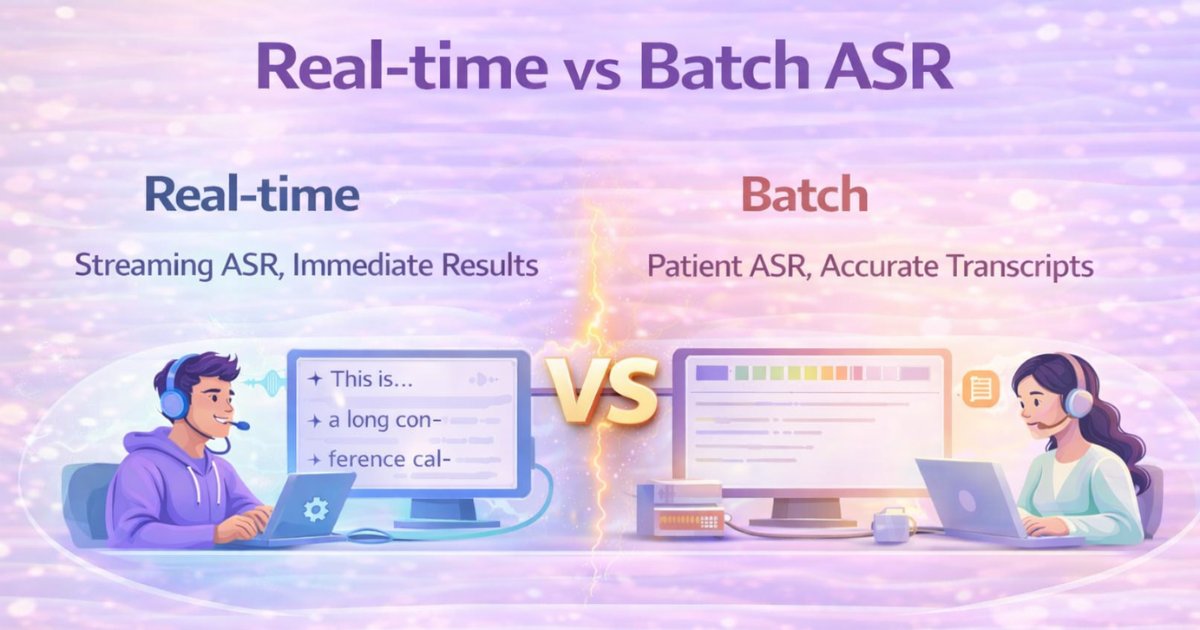
Batch ASR is patient. You record audio, send the complete file, and the system processes it, start to finish. It can rewind, reconsider, and optimize for accuracy because time isn't the main constraint.
Real-time ASR has no such luxury. Audio streams in as someone speaks. The system must transcribe words as they're being spoken and deliver results before the next chunk arrives. It's like reading a book while someone is still writing it, one word at a time, and you can't go back to revise.
Architectural Differences
Batch systems work like careful editors. They use bidirectional models that look both forward and backward in the audio stream. Something unclear at second 5? The model uses information from second 10 to figure it out. Process the complete file, apply post-processing, return the final transcript. Resource allocation is straightforward, you know the file size upfront, can parallelize processing, and can use larger, more accurate models without worrying about per-chunk latency.
Real-time systems work like simultaneous interpreters. They handle continuous streams, maintain state between chunks, and return results in milliseconds. Audio arrives in 100-200ms chunks through WebSocket connections. Each chunk gets processed immediately, context from previous chunks is maintained, and partial results stream back continuously. Memory usage must stay bounded even for long conversations, and models have to be smaller and faster, even if that means slightly lower accuracy.
The Trade-offs
Batch processing achieves higher accuracy because it sees the complete picture. But a 10-minute file might take 30 seconds to transcribe. For recorded meetings or podcast episodes, this is fine. For live captioning? Unusable.
Real-time systems sacrifice some accuracy for immediacy. They make decisions with incomplete context. If someone stutters or self-corrects, the system might initially transcribe it wrong, then fix it as more audio arrives. Users see text appearing as they speak, but "Weather in Berlin" might briefly flash as "Whether in Berlin" before autocorrecting.
How Each Breaks
Batch failure modes:
Out of memory crashes: A 2-hour meeting recording exhausts system memory when the server is handling multiple jobs simultaneously
Timeout failures: Processing takes too long, the client gives up, and the server wastes resources on results nobody's waiting for
Silent failure on bad audio: You wait 30 seconds only to get "... ... ..." back
Real-time failure modes:
Network instability: Brief hiccups mean lost audio chunks. Unlike batch where you retry the whole file, dropped audio in streaming is gone forever
Buffer overflow/underflow: Audio arrives faster than the system can process or slower than expected. The transcript drifts out of alignment, text appearing too late or mysteriously jumping ahead
Context loss in long sessions: For 2-hour conference calls, memory usage grows until the system must discard old context, hurting accuracy for callback references
Cascade failures: Early transcription errors poison later results. Mishear a domain-specific term early, and the system keeps repeating the same mistake
Resource exhaustion under load: Batch can queue jobs. Real-time must respond now. Under heavy load, users get cut off mid-conversation
When to Use Which
Use batch processing when:
You're transcribing recorded content (meetings, podcasts, voicemails)
Accuracy matters more than speed
Users don't need immediate results
Audio quality varies significantly
Use real-time streaming when:
Users need live captions or subtitles
You're building voice assistants or conversational AI
Interactive applications require immediate feedback
Audio quality is reasonably consistent
The Hybrid Mistake
Some teams try building one system that does both. "We'll just buffer real-time audio and process it like a batch!" This usually ends badly. You get the latency of batch processing with the complexity of streaming infrastructure. Pick the architecture matching your primary use case.
Where FonadaLabs Fits In
At FonadaLabs, we've built our ASR API to handle both patterns because Indian voice applications genuinely need them.
For batch processing, our REST API transcribes complete audio files optimized for diverse accents and code-mixed speech common in India. Upload your file, specify the language, get accurate transcripts.
For real-time use cases, our WebSocket-based streaming API handles live audio with low latency for live captions, voice bots, or conversational AI. Audio flows in as people speak, transcripts stream back immediately.
We don't compromise. Batch gets full accuracy treatment. Real-time gets genuine low latency without sacrificing support for Indian languages or code-mixing. Both paths are production-grade infrastructure.
The Bottom Line
Real-time and batch ASR aren't different speeds of the same thing. They're different architectures built for different constraints, with different failure modes and trade-offs.
Batch processing is careful and thorough. It fails slowly and predictably. Real-time streaming is fast and adaptive. It fails quickly and dramatically.
The worst ASR system isn't the one that's slightly less accurate, it's the one built for the wrong use case. A real-time system used for batch processing wastes resources. A batch system forced into real-time breaks user experience.
Choose the architecture matching how your users actually interact with audio. Build it properly, knowing exactly how it will fail and having a plan for when it does.
Because in production, it's not about if your ASR will fail. It's about how gracefully it recovers when it does.