
FonadaLabs Turn Detection
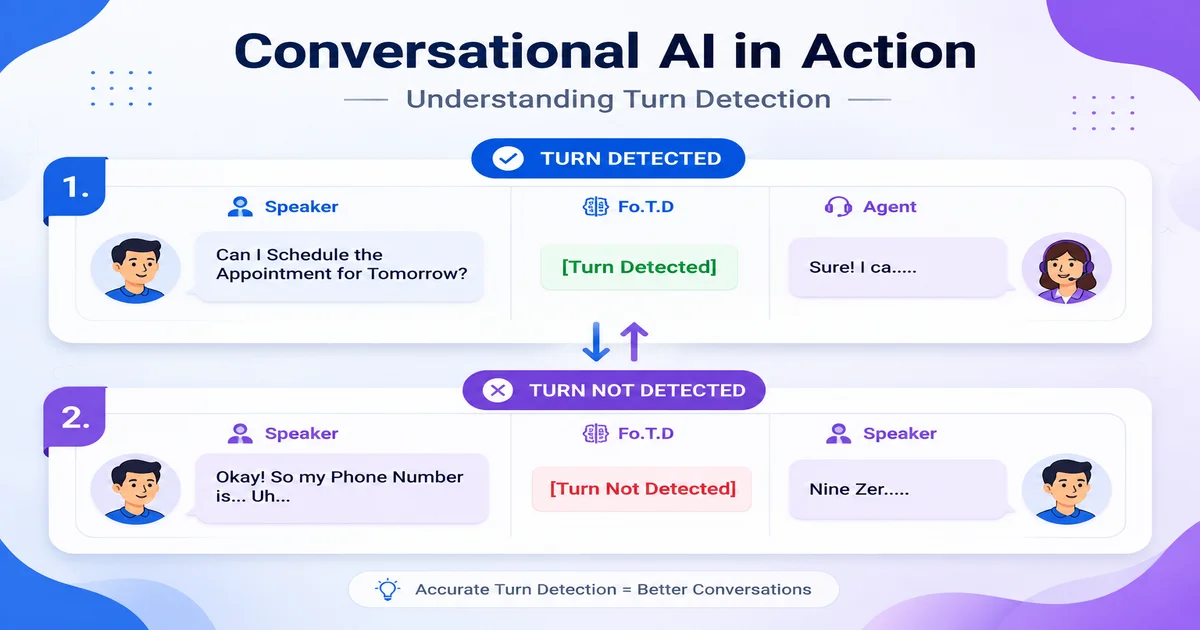
Fo.T.D → FonadaLabs` Turn Detection Model
Summary
One of the biggest challenges Voice assistants face is determining the right moment to speak, as Voice assistants are expected to respond naturally. If the assistant responds early then it interrupts the conversation, yet if the assistant speaks late it creates awkward silence. Although simple for humans to take turns, human speech is dynamic with natural pauses, hesitations, and varying speaking styles that make the process of turn detection difficult.
This blog explores the role of turn detection in modern voice to voice pipelines, the challenges of accurately detecting conversational turns, reviews the existing approaches, and introduces FonadaLabs' Turn Detection Model. In the last section of this blog, we have provided benchmark values against the existing solutions.
Role of Turn Detection
Turn detection is the process of determining when a speaker has finished speaking. It is a fundamental component of modern voice pipelines, enabling natural and responsive conversations without any interruptions or long stretches of silence.

Accurate turn detection is essential for delivering a seamless user experience. As simple silence detection is not enough for voice agents that are increasingly becoming better at conversation, Turn Detection provides a smarter solution to this problem.
Approaches for Turn Detection
Modern turn detection systems generally use one of three approaches, depending on the information they rely on to determine when a speaker has finished speaking.
1. Audio-Based Turn Detection
Audio-based models analyze acoustic cues such as pauses, speech activity, and variation of pitch and melody to detect turn boundaries.
2. Text-Based Turn Detection
Text-based models use speech transcripts to determine whether an utterance is complete. By analyzing sentence structure and conversational context, they can make more informed decisions.
3. Hybrid Turn Detection
Hybrid models combine acoustic and textual information to make turn-taking decisions. By leveraging both speech patterns and linguistic context, they provide more reliable turn detection.
Challenges in Developing a Turn Detection Model
Building a reliable turn detection model is significantly more challenging than detecting periods of silence. Human conversations are highly dynamic, and the signals that indicate the end of a turn vary across speakers, languages, and contexts.
1. Variability in Speaking Styles
Some speakers pause frequently while thinking, whereas others speak continuously with minimal gaps. A single rule or silence threshold cannot reliably handle all speaking patterns.
2. Distinguishing Pauses from Turn Endings
Not every silence indicates that a speaker has finished speaking. Natural hesitations, breathing pauses, and filler words can create gaps that may be mistaken for the end of a turn.
3. Generalization Across Conversations
A production-ready model must perform consistently across different accents, speaking rates, domains, and conversation scenarios rather than being optimized for a narrow set of conditions.
4. Gathering / Generation of Dataset
Training a reliable turn detection model requires large amounts of accurately labeled conversational data, which is difficult and expensive to obtain. Synthetic data generation helps fill these gaps, but it must be designed carefully to reflect natural conversational dynamics.
FonadaLabs Turn Detection Model
To address these challenges, we developed FonadaLabs' Turn Detection Model with a focus on accuracy and generalization. The model is trained and evaluated on conversations covering different speaking styles and pause behaviors, enabling it to perform consistently across a wide range of conversations. The result is a highly accurate turn detection system that minimizes both premature interruptions and unnecessary response delays, helping voice agents maintain natural conversational flow.
In the following section, we benchmark the FonadaLabs Turn Detection Model against leading turn detection models to evaluate its performance.
Benchmarking with Existing Models
The true measure of any turn detection model is its performance in real-world conversations. We benchmarked FonadaLabs' Turn Detection Model against two audio-based turn detection solutions using a common evaluation dataset covering diverse conversational scenarios across multiple Indian languages, under identical test conditions, to ensure a fair comparison.
Models Evaluated
Smart Turn Detection (v3.2): The latest and most capable Smart Turn Detection model, designed to predict conversational turn boundaries.
Krisp Turn Detection: Krisp's optimized turn detection model processes the audio stream in real time to identify natural turn boundaries while maintaining low latency.
FonadaLabs Turn Detection: FonadaLabs' newest model, optimized for accurate end-of-turn prediction with consistently low latency, enabling natural interactions in production voice AI systems.
The following sections present an objective comparison of these models using a unified benchmarking methodology and evaluation protocol.
Fig1. Language-wise Performance Comparison
Fig2. Overall Performance Benchmark Comparison
The benchmark demonstrates that the FonadaLabs Turn Detection Model consistently achieves strong performance across both overall accuracy and language-specific evaluations. The model remains robust across different conversational styles and speaking behaviors while maintaining low response latency. This consistency makes it well suited for production-grade voice AI applications where reliable turn prediction is critical for natural conversations.
Future Scope
No turn detection model is perfect, and continuous improvement is essential to building more natural conversational AI. We will continue to enhance the FonadaLabs Turn Detection Model by expanding support for additional languages, increasing accuracy across diverse conversational scenarios, and further reducing inference latency.
References
Krisp AI – Turn Detection Documentation